A website dedicated to the Eurovision orchestra and the 346 musicians who conducted it between the first contest in 1956 and the last live orchestra edition in 1998. By using the various indexes, a wealth of interviews with, and biographical information about musicians from all corners of Europe can be accessed - as well as backgrounds about the history of the Eurovision Song Contest, the San Remo Festival, and the Nordring Radio Prize. Feel free to roam around!
The following article is an overview of the career of French pianist, singer, composer, arranger, and conductor Guy Matteoni. The main source of information is an interview with Mr Matteoni, conducted by Bas Tukker in 2013. The article below is subdivided into two main parts; a general career overview (part 3) and a part dedicated to Guy Matteoni's Eurovision involvement (part 4).
Guy Matteoni arranged and conducted three French Eurovision entries: ‘Je suis l’enfant-soleil’ for Anne-Marie David (Jerusalem 1979), ‘Chanteur de charme’ for Gérard Lenorman (Dublin 1988), and ‘J’ai volé la vie’ for Nathalie Pâque’ (Lausanne 1989); for this last-mentioned song, Matteoni co-composed the music in collaboration with G.G. Candy. Moreover, Matteoni was involved as an arranger of two more songs, for which another conductor jumped in to take care of the Eurovision performance: Portugal’s ‘Dai-li-dou’ in 1978 and France’s ‘Vivre’ in 1983.
BIOGRAPHY
Guy Matteoni grew up in le Quartier de la Belle de Mai, a working-class neighbourhood in Marseilles which, in the years following World War II, was mainly inhabited by Italian immigrants.
“I grew up in modest conditions, but my family was a happy one,” Guy recalls. “Predictably, in a family with Italian roots, we listened to music a lot. My father liked jazz and owned an electrophone and a modest record collection. I was thrilled by what I heard. My grandfather played the accordion, and it was obvious to everyone around me that music meant everything to me. To make my grandpa proud, my parents decided to send me to an accordion teacher when I was seven years old. The woman they sent me to, Ms Eyries, wisely decided that, the accordion being somewhat too heavy for my tender shoulders, it would be better to first have a go at the piano. These were classical piano lessons, but there was time for a little chanson in each and every lesson. In hindsight, this was quite remarkable, given that these were the 1950s! Partly because of these varied lessons, I grew attached to the piano and, though I mastered the accordion later onwards as well, my predilection for this instrument has stayed with me for the rest of my life.”
At eleven years old, Guy went to the lycée and took up studying piano and solfège at Marseilles’ Regional Conservatoire simultaneously. “I stayed at the conservatory until I passed my piano exams in 1961. As a regular student, I was quite ambitious and I even embarked on studying law. By that time, however, I was so absorbed by my activities in music, that I left university after just one year. Some years before, when I was still in secondary school and the Beatles appeared on the music scene, I had gotten interested in pop music and formed little pop bands with my classmates. One thing led to another, and by the time I was a student, I earned quite some money by playing the piano in pop bands and small entertainment orchestras which performed in the Marseilles area. All the while, my love for jazz persevered. In 1961, I attended a concert of the Duke Ellington Orchestra and found myself being lured into a jam session with some of the musicians from his band right after the show. What an unforgettable experience!”
Matteoni gave up his law studies when one of the bands he was in, Les Cinq Gentlemen, was signed by the Barclay record company. The quintet with Corsican lead vocalist Jean Fredenucci played a mixture of covers and own repertoire.
Between 1964 and 1967, Guy Matteoni (with glasses) played the organ in beat group Les Cinq Gentlemen
“We formed Les Cinq Gentlemen in 1964. All five of us were fond of the music of the Zombies, the Rolling Stones, the Animals… in short, British pop groups. I was the band’s organ player and wrote the lion’s share of the arrangements. Initially, we just played covers, but we gradually started inserting our own compositions into our concerts. After we had been signed by Barclay and had had a considerable hit in France with ‘Dis-nous Dylan’ in 1966, an example of what I would call French psychedelic pop, we started receiving invitations to play at concerts all over the country. Quite often, we were the support act for bigger artists, while also nightclubs called upon us frequently. We had a great time together, but we did not make that much money and it dawned to me quite soon that we were not going to be as big as the Beatles!"
"In my spare time, I started studying arranging and harmony by studying textbooks. By way of practice, I wrote out arrangements by listening to pop records. I had not taken any harmony courses during my conservatory days. Deep down, I knew I wanted to be a studio arranger – this was my ambition cachée! Even back then, I could not imagine anything being more wonderful than writing an orchestral arrangement and having it recorded by a studio orchestra.”
The episode of Les Cinq Gentlemen was cut short when Guy was drafted into the army for sixteen obligatory months of military service (1967-68), which he spent in Radolfzell, West Germany. There, he formed and led the regiment’s entertainment band and played jazz with a local German group.
“When I got back to Marseilles in May 1968, I put up a band of four musicians, with which I performed in clubs and bars. We played the flavour of the day, Otis Redding and things like that. One year later, in 1969, the general manager of Le Vamping, which was one of Marseilles’ two main cabarets, approached me wondering if I was interested to form an entertainment orchestra for his club. A stroke of luck… imagine, even Paul Mauriat had once been the musical director of this particular cabaret! I expanded my band to 8 elements. The three years at Le Vamping were interesting, because I got the opportunity to accompany popular artists who performed in our club, such as Michel Sardou and Claude François. What was even better; I got to write the arrangements for their shows… very instructive, given my hidden ambition, of course! Simultaneously, I got involved in Edmond Tauber’s jazz big band, which comprised the best brass players of the French Riviera. Apart from playing the piano, I got to write some of the arrangements for this ensemble as well – my first scores for a genuine orchestra. This band was really good… we even did a couple of concerts with Phil Woods, one of America’s best avant-garde saxophonists.”
In the last months of 1971, Guy Matteoni decided he had to leave Marseilles to realise his dreams of being an arranger. “I was already 26 years old and I felt it was now or never. One day, I simply left for Paris without any concrete plans. I managed to find myself a place to live. But how to get into the record business? Luckily, thanks to my work with Les Cinq Gentlemen, I knew some people here and there. I wrote a letter to one of them, film composer Michel Magne, who had once invited our band to perform on two private soirées."
Guy Matteoni's 1974 solo single 'Je roule vers toi'
"The next day, Michel telephoned me and invited me to become his assistant. It was the best thing that could have happened to me. Michel owned a fabulous castle on the western fringes of Paris, Hérouville, in which he had installed a record studio for his film projects. The castle was popular with foreign artists and big names such as Elton John, Pink Floyd, and David Bowie all came to Hérouville to record their albums. I was given a room in the chateau to live in and worked for Michel for the next two-odd years. He was very generous and allowed me to write things on my own fairly soon. I was very sad when Michel ended his life in 1984, because I owe much of my career to him. Together with François Rauber and Georges Delerue, I would say he is the arranger who influenced me most profoundly.”
With Magne, Matteoni worked on several film scores, such as ‘Don Juan ou si Don Juan était une femme’ with Brigitte Bardot and ‘Moi y'en a vouloir des sous’ by director Jean Yanne, both from 1973. Thanks to Magne, Matteoni got to know some of Paris’ important producers, most notably Bernard Saint-Paul. Saint-Paul asked him to arrange many of his studio projects, amongst others with crooner Robert Carpentier, whilst he allowed the young arranger a record of his own as well, simply called ‘Marseille’ (1975).
“Bernard put a lot of confidence in me and, almost from the beginning, encouraged me to work on projects of my own. In ’73, I released an instrumental single called ‘Pianissimo’. Bernard was fond of my voice and he often asked me to do background vocals in studio sessions. In 1974, I released my first single as a solo singer and one year later, the concept album ‘Marseille’ saw the daylight. I wrote all music, lyrics, and arrangements for that record. The lyrics are about the Marseilles of my young years. A single from this album, ‘Rue Saint-Ferréol’, was a modest hit success. That album was my baby and I was very grateful to Bernard for giving me the opportunity to create it.”
In 1973, Matteoni got in touch with singer-songwriter Gérard Lenorman and his producer Jean-Jacques Souplet. With some short interruptions, Guy continued working with Lenorman for the next thirty years, writing loads of record arrangements for him, including some of his biggest hits, such as ‘La ballade des gens heureux’ (1975), ‘Voici les clés’ (1976), and ‘Si j’étais président’ (1980). Moreover, he composed Lenorman’s success song ‘Soldats ne tirez pas’ (1974) and was his musical director in countless stage shows across France and beyond.
'Rue Saint-Ferréol', the single taken from Guy Matteoni's 1975 solo album 'Marseille'
“Gérard heard one of my orchestrations for Robert Carpentier and he liked what he heard! He asked Souplet to contact me and that is how our collaboration got started. Gérard had already had some hits, but his major record successes were with me! Gérard is an excellent singer and performer. He has always succeeded in moving his audiences with beautiful melodies and poignant lyrics. He asked a lot of himself and the people around him, including me… but we got along extremely well. In the 1970s and 1980s, I must have written some one hundred arrangements for his records. Later onwards, I continued working with him on stage, for the last time in 2004.”
Working with Saint-Paul, Souplet, and other producers, Guy Matteoni quickly became one of Paris’ most sought-after freelance record arrangers. In the 1970s, he penned scores for the likes of Charles Trenet, Adamo, Francis Cabrel, Jeane Manson, Hervé Vilard, Nicole Croisille, David Alexandre Winter, Michel Sardou, Marie Myriam, Gérard Palaprat, Nicole Rieu, Claude François, and international stars such as Gigliola Cinquetti (Italy), Petula Clark (Britain), and Ajda Pekkan (Turkey). Moreover, he was involved in writing the arrangements to all hit successes of Dave, most notably ‘Trop beau’, ‘Vanina’, ‘Dansez maintenant’, and ‘Du côté de chez Swan’ (all from 1974-75).
When asked about the secret of an effective hit arrangement, Matteoni says, “Each arranger has his own methods and tricks. In the old days, these used to be referred to as ‘gimmicks’, whilst nowadays one mostly speaks of ‘hooks’… these are elements in the instrumentation that listeners easily remember. In its most basic form, the recurring guitar riffs in ‘Satisfaction’ by the Rolling Stones are a prime example of such a hook. Such repeated sound effects can help bringing about chart success for a song. Among the ‘don’ts’ for an arranger, I would say the main one is following one’s own musical preferences too heavily, thereby forgetting what a particular vocalist needs in a particular song. One runs the risk of ruining the artistic value of the song by ignoring the artist."
"My favourite record project? I would have to go for ‘Je t’écris’, an album for Eric Charden from 1980. It contained the single ‘L’été s’ra chaud’, a disco track, which I co-composed with Eric. Moreover, I arranged all songs included on it. Eric allowed me to voice my ideas about the project and almost all of these ideas were honoured. I was and still am proud of the result.”
Céline Dion's 1982 single 'D'amour ou d'amitié' was orchestrated by Guy Matteoni
Apart from his work for other artists, Matteoni continued releasing the odd instrumental solo project, including an album called ‘America’ (1978) and the 1981 single ‘Un piano sous la pluie’. He arranged the music to several television programmes, most notably the signature tunes of cartoon series San ku kai (1976) and Albator, le corsaire de l’espace (1978), both compositions by Eric Charden. In spite of his ties with Michel Magne in the early 1970s, Matteoni never really made his mark in the world of film music, signing for the arrangements to just a handful of titles, including Vive la vie! and Gwendoline (both 1984).
“I cannot really say I regret the fact that no breakthrough in the film business happened. I was never looking for such a breakthrough, mainly because the work itself and the film business as a whole did not really appeal to me. Moreover, in those years, I had more than enough work in pop music.”
In the period 1980-89, Guy Matteoni continued to work in the record studios in Paris, writing arrangements for artists such as François Valéry, Marcel Amont, La Bande à Basile, C. Jérôme, Dalida, Plastic Bertrand, Richard Anthony, Isabelle Aubret, Mireille Mathieu, Guy Mardel, Pierre Bachelet, and Annie Cordy. In this decade, he was co-responsible for several new hits, including ‘Elle’ by Didier Barbelivien (1980), ‘D’amour ou d’amitié’ by Céline Dion (1982), and ‘Et toute la ville en parle’ by Michèle Torr (1987). For Céline Dion, he also penned the score to ‘Tellement j’ai d’amour pour toi’, with which she represented France at the 1982 World Popular Song Festival in Tokyo and came third.
Slowly, however, Matteoni started withdrawing from the Parisian metier, desiring to return to Southern France. In 1986, together with sound engineer Claude Mainguy, he founded a record studio in Bouc-Bel-Air, close to Aix-en-Provence.
“The reason is quite simple”, Matteoni explains. “I had had enough of Paris, j’en avais marre! In the 1970s, when you worked in the studio business, living in Paris was a first requirement. The 1980s, however, were the days of the synthesizers, the TGV, and improving air connections in France! In 1986, I came back to the Riviera and put up this new studio, whilst continuing my work in Paris with Pierre Bachelet and others… Je me baladais entre les deux, I travelled to Paris and back again. Mainguy and I had a huge success in 1988 with our studio project Debut de Soirée and the dance hit ‘Nuit de folie’. We were a good team… we got along well and were both quite all-round as songwriters, producers, and engineers. After the Debut de Soirée episode, we recorded several other things in our studio, including Nathalie Pâque’s single ‘Bébé bambou’ in 1990. In the 90s, however, the music industry rapidly changed… rap and boy bands were not exactly my cup of tea and arrangers were less and less in demand. Therefore, I progressively focused on other activities.”
On tour with Peter & Sloane for the Âge Tendre stage show (2011)
The main of these activities for Matteoni was doubtlessly constituted by live performances. As a pianist and musical director, he had been working with some of France’s best-loved singers from the 1970s onwards, and he continued accompanying Pierre Bachelet and Gérard Lenorman until well into the first decade of the new millennium. Others Matteoni worked with on live gigs include Dave, Alain Souchon, and Michèle Torr.
“I love being on stage. Travelling around is one thing, but performing with a group of musicians to entertain an audience which is right in front of you is something I adore. Especially with Gérard Lenorman and Bachelet, I did countless tours. Simultaneously, there were always other projects which came along, such as arranging the musical comedy ‘Les enfants du soleil’ in 2004. That project, written by Didier Barbelivien and Cyril Assous, took me some nine months of work in a studio in Paris. I also arranged Didier’s solo album ‘Envoie les clowns’ in 2005. Another interesting commission was Julio Iglesias’ 2007 album ‘Quelque chose de France’, for which I wrote part of the orchestrations.”
In 2006, Matteoni embarked on an unprecedented series of eight consecutive tours with Age Tendre, a show with popular artists from the 1960s and 1970s and live accompaniment. Between 2006 and 2014, Matteoni was the musical director of hundreds of concerts across France and Belgium.
“Age Tendre is the brainchild of Michel Algay, Gérard Lenorman’s producer. He asked me somewhere in 2005 if I thought it an interesting idea. We started out in 2006 without knowing if the formula would catch on with the public. The first three months were hard, but then the audiences started growing bigger and bigger. Can you imagine: eight tours consisting of sixty to seventy concerts a year? We were joined by many singers, including, amongst many others, Marie Myriam, Demis Rousso, Gilles Dreu, and Rika Zaraï. I worked with an orchestra of twelve elements and a group of backing singers. In the sixth and seventh season, we were backed up by a fantastic symphonic orchestra from Hungary. Meanwhile, Michel has come up with a new concept, Sacrée soirée, with artists from the 1980s and 1990s. The first tour will take off in 2014 and I will be the musical director once again.”
From 2008 onwards, Guy Matteoni has been the deputy mayor of Marignane, whilst being responsible for all cultural activities in that town to the west of Marseilles as well.
Matteoni about this striking career move, “In 2008, Eric le Dissès was elected mayor of Marignane. Being a friend to my wife, he decided to ask me for the job of cultural chargé d’affaires. I accepted on the condition that I could remain unaffiliated to any political party. My responsibilities extend to all music, dance, and theatre schools as well as all museums and cinemas in Marignane. Moreover, I have supervised the organisation of several open air concerts. In 2014, new elections will take place and we shall see what the political future brings.”
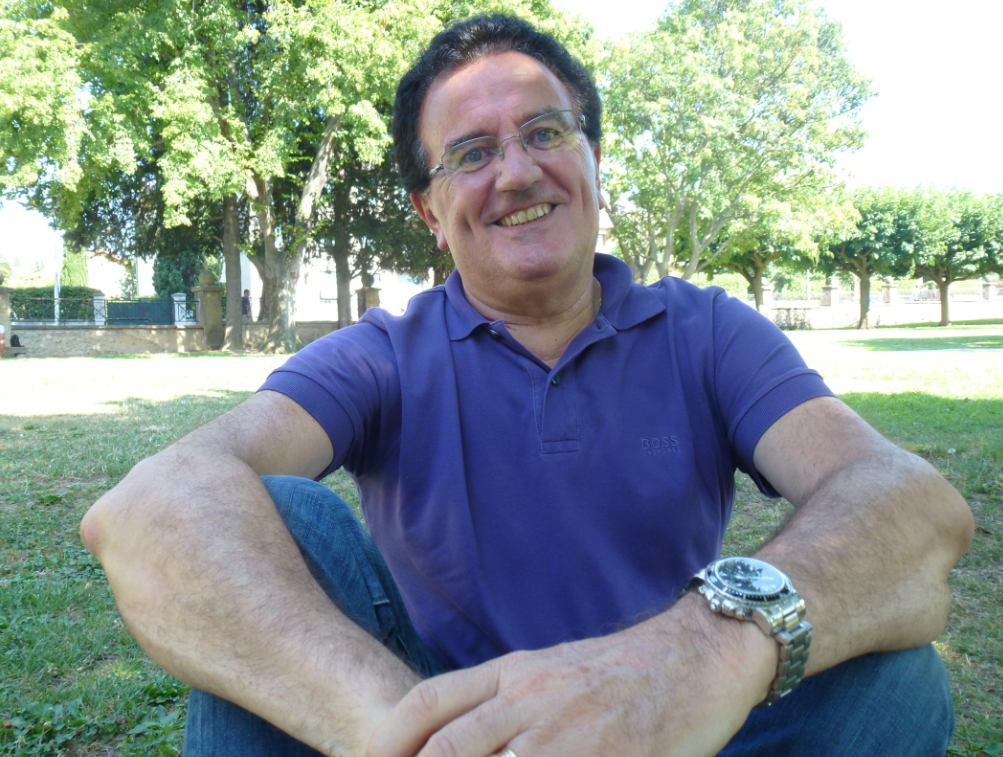
Interviewed for this website, Aix-en-Provence - July 2013
EUROVISION SONG CONTEST
Guy Matteoni conducted three French Eurovision entries, but his involvement in the contest runs deeper than that. He arranged countless French pre-selection songs in the 1970s and 1980s. “In 1981, I even scored seven or eight of the eleven entries in the French selection show, which was slightly problematic, because all ‘my’ artists were wondering if I had written a better arrangement for one of their rivals.”
Apart from the three songs he conducted himself, Matteoni wrote two more scores for which the orchestra was placed under the baton of another maestro, Portugal’s ‘Dai-li-dou’ by Gemini (1978) and ‘Vivre’, with which Guy Bonnet represented France in Eurovision 1983. The conducting honours for these entries were taken by Thilo Krasmann and François Rauber respectively.
“As for that Portuguese song, I hardly remember a thing about it. It must have been the group’s record company which commissioned me to write that orchestration. Quite understandably, the Portuguese preferred a conductor from Portugal to lead the Eurovision orchestra instead of me."
"I was equally happy to leave the conducting of ‘Vivre’ to François Rauber in 1983. I had written that score, but was unable to accompany Guy to Munich, as I was on tour with Pierre Bachelet. François, who had been the musical director of the French selection show, was a more than worthy replacement. I had the utmost respect for him as a person and as a professional and it was an honour to work with him on an album by Jacques Debroncquard, an excellent singer in the style of Jacques Brel. Though I naturally knew Guy Bonnet, as we were both from the south of France, this Eurovision project must have been about our only collaboration. ‘Vivre’ was a standard Eurovision song, nothing more and nothing less.”
French single release of Gemini's 1978 Portuguese Eurovision entry 'Dai-li-dou'. The group included future Eurovision conductor Mike Sergeant (far right in the picture)
Matteoni’s first Eurovision performance was in 1979, when France was represented by Anne-Marie David, who had won the festival for Luxembourg six years previously. Her 1979 song, ‘Je suis l’enfant-soleil’, was penned by the experienced songwriting team of Eddy Marnay and Hubert Giraud. Matteoni wrote the arrangement, which he conducted himself in the international festival final in Jerusalem, where France came third behind Israel and Spain.
“I was contacted by Claude Pascal to arrange Anne-Marie’s song,” Guy recalls. “Claude was the editor of this record. Writing the score was made easier due to the fact that composer Hubert Giraud, a great musician for whom I arranged quite many songs over the years, knew well what he wanted it to sound like. He came up with the rhythm, for example. So when the song came my way, the main construction work, so to speak, had been done already. The result was a ballad tailor-made for a competition such as the Eurovision Song Contest.”
“As for Anne-Marie David, I had worked with her before, composing her song ‘Trop’, which even was a modest hit success a couple of years prior to the Jerusalem festival. In spite of that, in Jerusalem, I hung out more with the representatives of France 2, the television company, than with either the songwriting team or with Anne-Marie herself. We were in the same hotel, but that was about it… there was much more mutual sympathy between the artist and me in the two other contests I was involved in later onwards. In Jerusalem, it was nice to meet some other French musicians, such as Hervé Roy who conducted Jeane Manson’s song for Luxembourg. Laurent Vaguener was Monaco’s representative; we met him and his conductor Gérard Salesses on our flight from Paris to Israel. Of course, Hervé and Gérard were familiar faces from the Parisian record studios. I sympathised a lot with the Israeli singers, who eventually won the contest with ‘Hallelujah’. Accidentally, I met Gali Atari and her producersome time afterwards in a record studio in London, which was pleasant.”
“It was special to work in Jerusalem. I had never been there before and I was overwhelmed by the atmosphere. Conducting the orchestra in these circumstances gave me goosebumps. The conducting itself did not make me especially nervous. I never became a trained conductor in the classical sense, but I had acquired the basic techniques in the recording studio in the preceding years. One cannot make some random movements and expect an orchestra to perform well – especially the string players with their classical education will not like that and will begin gossiping about you behind your back – but it is not the most difficult thing imaginable. I have never encountered any problems, either in the studio or on stage. Throughout the years, I have always had a good working relationship with the musicians in the orchestras I worked with. Generally speaking, in my three Eurovisions, I never had any problems or hiccups with the orchestra in rehearsals or during the concert itself.”
“One day, I went on an excursion to Masada and the Dead Sea with some members of the French delegation. We left early in the morning, knowing we had to be back late in the afternoon for a rehearsal with Anne-Marie and the orchestra. We were accompanied by a guide and had a magnificent day out. We travelled back through the occupied West Bank territories, but had forgotten about all road blocks where Israeli soldiers were checking on everyone passing by! It took us far longer to get back to Jerusalem than we had anticipated… and to cut a long story short, I was late for the rehearsal. We were not that much late – 10 or 15 minutes – and therefore the organisation turned a blind eye and let us go ahead. Because there was no time to change, I conducted the orchestra dressed in shorts… and with the skin of my face red and burning!"
"Afterwards, I was told we were lucky – the EBU could have disqualified our song because of our making a mess of the rehearsing schedule. Anne-Marie, who was totally determined to win the competition, was beside herself with anger… how could I have let her wait? Her anger became even more impressive during the voting when it transpired France would not win. While the votes were coming in, she was tense to the point of emotional breakdown.”
Anne-Marie David on the Eurovision stage in Jerusalem (1979)
Nine years later, in 1988, Matteoni appeared on the Eurovision stage as a conductor for the second time. Gérard Lenorman, 43 years old at that time, represented France with a song he had written himself in collaboration with Claude Lemesle: ‘Chanteur de charme’. Quite naturally, Lenorman turned to Matteoni, with whom he had worked uninterruptedly for fifteen years, to write the arrangement and conduct the festival orchestra in Dublin, Ireland. In spite of a magnificent orchestration and Lenorman’s convincing performance, ‘Chanteur de charme’ finished in a somewhat disappointing 10th position with 64 votes.
“Gérard did not want to sing the song himself,” Matteoni comments. “He had submitted it to the selection board of French television with the intention of giving it to another performer. The committee then contacted him with a simple message: we will not choose your song for the contest, unless you perform it yourself. Gérard must have felt a little apprehensive about doing Eurovision, but in the end he agreed. We were left with very little time… Gérard came down to my studio in Bouc-Bel-Air, where we recorded a very basic version of the song with just synthetic instruments. Upon that, I had a couple of weeks to work that initial version up to a live orchestration suitable for the Eurovision orchestra in Ireland. I really like this particular orchestration and the Irish musicians played it excellently.”
“We were told we were one of three delegations seriously threatened by terrorist groups. The other two countries were Israel and West Germany. This is all that was told to us by Irish police; we weren't given any details. The organisation didn't take this information lightly and attached a security officer to each member of our delegation. This bodyguard was at your side from the moment you left your hotel room at the beginning of the day to the time when you returned there in the evening. The situation made all of us a little nervous. During our free time, we tried to escape our guards, but to no avail. One day, Gérard and I made a stroll in the centre of Dublin. Some Irish youths wanted to have a chat with us, but they were immediately sent away by our guards. As you can imagine, I didn't get to see much of Dublin that week… which was a pity, because it is such a pleasant town!”
“With Céline Dion amongst the competitors, I was pretty sure we wouldn't win, but I expected us to finish amongst the first five. Gérard surely wanted to win and he prepared for his performance meticulously, as always. He is such a perfectionist! He was always nervous until the moment he went on stage – that was his way. I was so disappointed for him… to my mind, he deserved more. The song was good! When I listen to it now, 25 years later, it still sounds fresh and modern to me – certainly when compared to ‘Je suis l’enfant-soleil’ by Anne-Marie David, which has really turned into a song of a past era. In the late 1980s, Gérard went through a difficult period in his career. His live shows still drew large audiences, but his record sales had plummeted dramatically. He must have hoped for some new energy with a good result in Dublin, but it was not to be.”
One year later, in 1989, Matteoni was once again involved in the French Eurovision entry as an arranger and conductor. What was more, he had co-composed ‘J’ai volé la vie’ with G.G. Candy. After this song had been picked by French TV internally, it was performed at the international festival final in Lausanne (Switzerland) by an eleven-year-old girl from Liège, Belgium, Nathalie Pâque, who picked up 60 points and came eighth amongst twenty-two competitors. How did Matteoni get in touch with this young Belgian songstress?
“Nathalie was a discovery of editor Max Amphoux. He introduced her to G.G. Candy and me, requesting us to write some material for her. I met Nathalie for the first time at G.G.’s place in Paris. G.G. – his real name was Roger – and his wife Vava had been in Michel Fugain’s accompanying group, Le Big Bazar, and, being a close friend of theirs, was regularly invited over to their place, just outside of Paris. On such evenings, G.G. and I often ended up at the piano, trying to create a new song. That is exactly how ‘J’ai volé la vie’ was composed, of course with Nathalie’s impressive vocal abilities in mind. Later onwards, Sylvain Lebel wrote lyrics to the melody and Max Amphoux suggested it to TV channel France 2 for the Eurovision Song Contest. That is how the song was selected. I wrote the orchestration and decided to have the rhythm elements as well as the saxophone solo pre-recorded – just to make life a little bit easier in Lausanne.”
In Lausanne, the songwriters of ‘J’ai volé la vie’ were given a hard time by the Swiss press. “Journalists claimed we took advantage of a child… they called it child labour. We were not expecting this negative approach. The most annoying thing was that the same question was put to us day after day. At one point, I answered that if one had taken the same attitude 200 years ago, there would have been no Mozart."
"Fortunately, Nathalie herself was unstirred by all of this. She had her mum and dad to care for her and they kept her away from press attention. She did an excellent job on the song. It was amazing to see such a young girl being so confident on stage. Any artist is in need of the support of the musicians around him, but a girl like Nathalie… she simply did her thing without caring too much about what was happening around her. We were hoping for a good result for her, perhaps even a victory, but an eighth position was not all that bad. Things were complicated a bit due to Israel coming up with a child singer as well; this took away some of the uniqueness of our entry. Nonetheless, the contest in Lausanne was primarily a good experience. I had a great time with G.G. and the representatives of France 2. In spite of some follow-up singles I produced for Nathalie, she did not rise to stardom in France. Later onwards, she performed in musicals. Elle se débrouille, she is doing well!”
“Even at that time, back in the 1980s,” Matteoni concludes, “the officials of French television who were in our delegation told me, “A second place would be the best possible result!” They were not all that keen on winning because of the costs of organizing the contest the following year. I did not pay much attention to that. I simply wanted to do well… the fact that one represented France, made it all the more special. It was as if being a sportsman, defending the tricolour. Though I cannot say these three Eurovision appearances changed my career, I was happy and proud to conduct the French Eurovision entry three times. I look back on these three contests with the utmost of pleasure.”
Nathalie Pâque rehearsing her performance of 'J'ai volé la vie' with Guy Matteoni in the foreground conducting the orchestra. Picture taken by - and published by kind permission of - the orchestra's pianist, Rui dos Reis
OTHER ARTISTS ABOUT GUY MATTEONI
So far, we have not gathered comments of other artists about Guy Matteoni.
The following article is an overview of the career of Finnish trumpet player, composer, and conductor Ossi Runne. The main source of information is an interview with Mr Runne, conducted by Bas Tukker in Helsinki, August 2015. The article below is subdivided into two main parts; a general career overview (part 3) and a part dedicated to Ossi Runne's Eurovision involvement (part 4).
Born: April 23rd, 1927, Viipuri (Finland, modern-day Vyborg, Russia)
Died: November 5th, 2020, Helsinki (Finland)
Nationality: Finnish
SHORT EUROVISION RECORD
One of the familiar faces in the Eurovision Song Contest for over two decades, Ossi Runne conducted no fewer than 22 Finnish festival entries. Only Noel Kelehan took part in more editions of the festival (25 times). Between 1966 and 1989, Runne only missed out in 1970, when Finland joined the Scandinavian boycott of the contest, and 1981, when he was replaced by Henrik Otto Donner.
BIOGRAPHY
Yrjö Osvald ‘Ossi’ Rundberg was born in 1927 in the town of Viipuri (Vyborg) on the Karelian Isthmus, which was part of Finland in the interwar period (1917-39). In the Finnicisation wave of the 1930s, his family decided to do away with their Swedish surname, adopting the Finnish-sounding ‘Runne’ instead. Ossi’s father ran a pastry shop.
“But my father was also a keen amateur musician,” Ossi recalls. “Being quite a good accordionist, he was a member of several dance bands. My mum sang in choirs. In our house, there was a lot of music. My parents enjoyed cultural life in Viipuri. They were fond of music theatre and often went to see operettas. When my mother noticed how much I liked singing along to her and how quickly I picked up the melodies of the popular waltzes and foxtrots my father was playing, she sent me to the local music school.”
As a toddler (1928)
Between 1935 and 1939, young Ossi studied the violin at the Viipuri Music Academy with teacher Onni Suhonen. “Looking back, I was very lucky to meet Suhonen there. He was one of many educated people who had escaped from Saint Petersburg in the aftermath of the Russian Revolution. Some of the conservatoire teachers from Petrograd fled to nearby Viipuri and were employed at our music academy. Suhonen, who had studied the violin in Vienna, was one of them. He was a very good teacher with an approach which, in retrospect, was quite modern. Instead of demanding hard work and exercise, he presented everything in a happy, natural, and playful way. That was clever of him, because he motivated me to such an extent, that I was practicing his lessons voluntarily every day.”
On the 30th of November, 1939, the Soviet Union started its invasion of Finland by bombing Vyborg. Runne: “That morning, I was just packing my school bag. Suddenly, there was an alarm. We had been practicing what to do in case of an attack and ran to our shelter, which was some streets away from our house. After some time, I saw three Russian bombers flying over the town and dropping their ammunition. After half an hour, we thought everything was over. I had just one thing on my mind: going to school! However, when we went back to our house, all that was left was rubble. Everything was razed to the ground. There was nothing we could take with us from the ruins. I lost my violin, but also – and that made me even sadder – my new ice skates!"
"We were unlucky that our house had been hit, because this first bombardment was not that extensive yet. Most of the town had been left unharmed. Later that day, in a radio broadcast, it was announced that all women and children were to be evacuated. Whilst my father and older brother went away to serve in the army, my mother and I took refuge in the country house of relatives, some hundred kilometres away from Viipuri. Little did we know that our town was forever lost to Finland. After the fall of the Iron Curtain, I have been back to Viipuri several times, but nothing reminds me of what the town was like when I grew up. The old historic centre has gone. It is so depressing. Usually, armies come and go, yet the civilians stay – but that is not the case of Viipuri. Not a single Finn is left…”
Ossi Runne (seated, second from left) in the Ossi Aalto Orchestra, 1946
In March 1940, the Winter War was over. Vyborg and the Karelian Isthmus had to be given up by Finland to the Soviets. Owning no more than the clothes they were wearing, the Runne family settled in Helsinki. Young Ossi had just finished elementary school, but what to do now? There was no money for further education.
“My uncle Urho was a musician in the Military Band of the Dragoon Guards. Somehow, I thought to myself, "Why could I not follow in his footsteps?" In the military band, everything – food, clothing, school – would be free. After having discussed it in the family, my uncle managed to arrange an audition with Artturi Rope, conductor of the Finnish Guards’ Band. He gave me a test, which, to my mind, was extremely easy; I had to sing along to him at the piano and there was a rhythmical exercise. After that, I was immediately accepted into the band.”
13-year-old Ossi became a member of the band’s students’ class, consisting of 16 boys. Simultaneously, he was allowed to continue his violin studies at the Sibelius Academy of Music. “Unfortunately, my violin teacher was a very strict and old-fashioned German. I did not like him at all. After a year or two, I gave up the violin. For the band, of course I had to find another instrument. After trying my hand at the oboe for some time, I picked the trumpet – well, in fact, Rope picked it for me! In spite of that, I soon took a liking to my new instrument. I studied the trumpet at the academy for 12 (!) years with Uno Koivu as my main teacher. I was always one step ahead of my fellow students of the military band thanks to the excellent theoretical background I had been given at the Viipuri Academy. Within months, with a couple of other boys of the military music school, I found myself playing the signal horn at military funerals."
The young trumpet player (1948)
"In September 1940, our group also performed in public at an athletics’ competition between Finland, Sweden, and Germany in Helsinki’s Olympic Stadium. After one year, I was allowed as a member into the military band proper. We played at military parades and funerals; though it was not just military music we played, but also Wagner, Schubert, and even Tchaikovsky’s operas. The education within the army was at least as important as those at the academy. Artturi Rope even gave me and the other students of the band some conducting lessons – very useful, in hindsight! Having become a member of the army band at such a young age, I can hardly say that becoming a professional musician was a conscious choice, but… I would not have wanted it any other way.”
Almost immediately after the Finnish-Soviet armistice in September 1944, Ossi Runne was immersed in Helsinki’s popular music scene. With accordionist Matti Viljanen, pianist Jaakko Salo and two others, he formed a quintet which specialized in dance music.
“During the war, the situation in Finland was strange. On the one hand, we were not occupied and therefore American films were shown in our movie theatres. From these films, we knew of the orchestras of Harry James and Glenn Miller. On BBC radio, we could legally listen to the popular English tunes; for us youngsters, this was interesting. On the other hand, while there was still a war on, the government explicitly forbade people to dance. Understandably, upon war’s end, everybody wanted to have a good time after years of restraint. In Helsinki, little and big bands sprang up by the score, performing in dance halls all around town. Around that same time, some civil musician came to see which musicians from the military band could be of use for playing dance music – and I was one of those who he wanted. At that point, I knew nothing about that new type of music. I did not even know who Louis Armstrong was. From the very first time we were practicing these novel arrangements, however, I liked them. I obtained a sheet music booklet with some of Armstrong’s phrasings. By copying them, little by little, I learned to play trumpet in this style.”
On a tour in Lapland with singer Henry Theel (1948)
With his sight-reading skills and staunch theoretical background, Ossi Runne became much sought-after as a trumpeter in Helsinki’s music scene. In 1945, he was involved in a studio recording of dance music for the first time. That same year, he joined the dance orchestra of Ossi Aalto, leaving the Guards Band once and for all.
Explaining his choice, Runne says, “It dawned to me pretty soon that I would be able to make a good living by playing in dance bands. As a musician of the military band, I made three marks a day, while one night of playing in a dance hall could earn up to one hundred marks! Ossi Aalto had the best dance orchestra in Finland and was always looking for the best musicians to work for him. He wanted me to play lead trumpet right from the start. I had never done that before, but I was eager to learn and by listening to some other fellow and copying his style exactly, I managed. We toured everywhere in Finland – and even in Sweden."
"Life was very different from what I had been used to in the Guards Band. Usually, we worked until late at night. I did not always like that, but I liked to play; and that is what we did, day in, day out. From Sweden, new arrangements from America slowly flowed in. We learnt about bebop – Dizzy Gillespie and Miles Davis. It was so different from everything I had heard before! We tried out some phrases and harmonies and, after a while, it went pretty well, but we soon realized that our audiences were not looking for such complicated music. They simply wanted us to play the popular dance tunes.”
The Toivo Kärki band, with the bandleader himself standing at the vibraphone to Ossi Runne's left (1949)
Runne stayed with Ossi Aalto for four years (1945-49). During this period, he also occasionally joined up with other, smaller dance bands, such as the Rytmi-Pojat, with which he toured the Åland Islands. In the following years, Runne played in the dance orchestras of Toivo Kärki (1949-51), Olle Lindström (1951), Erkki Aho (1951-53), and Al Stefano (1954). Why did he change bands so often in those years?
“Well, I wanted to learn. The Aalto orchestra was a big band in which I played lead trumpet. Toivo Kärki asked me when he went on tour with just five musicians and a singer, Henry Theel. I wanted to experience what it would be like to be the only trumpet player in the band – after all, in such a set-up, a totally different approach was needed. Erkki Aho had a ten-man-band which played at Restaurant Kaivohuone in Helsinki. We played typical background music… international variety numbers. I joined Al Stefano for just five months. Stefano (John Steffensen in real life - BT) was a Danish drummer who had specialized in Latin American music. For our performances, we dressed up as Mexicans, but the music we played was pretty advanced. We did an international tour, performing in Copenhagen and The Hague.”
Meanwhile, Ossi Runne had become a household name for Finnish radio listeners overnight. At the request of Scandia Records, he recorded a cover version of Eddie Calvert’s ‘The Song Of The Golden Trumpet’ (or in Finnish, ‘Kultaisen trumpetin laulu’), which became a huge hit in Finland in 1954.
Performing with the Erkki Aho Band at Restaurant Kaivohuone in Helsinki (1952)
“I had been involved in all kinds of different recording sessions for several years, but ‘Kultaisen trumpetin laulu’ was my first solo recording. In the early 1950s, there was an English trumpeter called Eddie Calvert who was immensely popular in many countries with his solo instrumental recordings. One of them was ‘The Song of the Golden Trumpet’. It was played very often in Finnish radio. People wanted to buy the record, but it was not available in Finland – they could not even find out who owned the British recording. Therefore, some guy at Scandia Records wondered if I could play it. He wanted the record to sound exactly like Eddie Calvert’s – and therefore Matti Viljanen copied the arrangement of the English original, while I adopted Calvert’s unusual style."
"Two weeks later, it was available in the shops and it sold quite well. This one record meant a lot to me. All symphony orchestras in Finland occasionally had light music concerts and I became their favourite choice for such guest performances. This required building up a new repertoire very quickly, because nobody in Finland had ever made an attempt at this genre before. I recorded several more singles and performed in countless concerts in the 1950s and 1960s. With the arrival of The Beatles and other guitar bands in the 60s, my style of playing was increasingly perceived as outdated, though I kept on doing some gigs here and there for many more years.”
In 1955, Ossi Runne made a surprising career move. Leaving for Stockholm, he became the conductor of the 17-man-strong China Theatre orchestra. “In fact, Ekhardt Lundin, the theatre’s manager, was looking for a trumpet player and called a booking office in Helsinki, which recommended me. To check if I had what it took, Lundin came down to Finland to see me play in the Erkki Aho Band. After that evening, it turned out he was so impressed that he wanted me as a conductor! Why? I do not have a clue, but to me it was another opportunity to try my hand at something new. Although I had had some training as a conductor in the military band, I was lacking experience, so I realised this would be tough."
Conducting the China Theatre Orchestra in Helsingborg, Sweden, during a concert tour (June 1955)
"After my 5 months with Al Stefano, I moved to Stockholm. The China Theatre was a fine and famous venue right in the heart of town. I stayed there for just a year, but this proved to be a very important part of my learning curve. It was extremely hard work. Every month, we had one programme with, let us say, 16 numbers. There would be a ballet and some famous singer or solo musician, perhaps a comedian. We always received the arrangements very late – usually just one day before we had to play them. With just one day between the last rendition of the old show and the premiere of the new month’s programme, I had to work like hell with the guys in the orchestra to study the music. It was here that I really learned how to be a conductor. Moreover, in Stockholm I met the virtuoso Mexican trumpeter Rafael Méndez, who played as a guest soloist in our theatre. I admired him a lot – his style was beautifully melodious and very fast. He allowed me to use some of his solos for my own trumpet performances in Finland, which was very generous of him.”
Though Ekhardt Lundin desperately wanted him to stay on, Ossi Runne decided to come back to Finland. “As a music professional, staying in Sweden would have been an attractive option, but I had a young lady in Helsinki. Kaarina and I got married in 1956. Back in Finland, I founded my own band, with three trumpet players, a trombonist, a saxophone player, and full rhythm section. I took care of writing most of the arrangements myself. Olavi Virta became our singer. He had a fantastic voice and really could sing anything, ranging from Sinatra and Fred Astaire’s repertoire to tangos, Italian film songs, and Finnish folk music. Following the taste of the Finnish audiences at that time, he mainly performed tangos and Italian songs during his years with my orchestra. I also made several records with Olavi, most of which we recorded in the Triola studios in Stockholm. When Olavi left the band in 1962, we replaced him by a young and talented girl called… Marion Rung!”
While leading his own orchestra in countless performances across Finland, Runne simultaneously worked as a conductor and producer at Fazer Records. Fazer was one of the most powerful record companies in Finland at that time. Runne stayed with Fazer for 8 years (1957-65). How did he get into the recording industry?
At work in Fazer's recording studios (early 1960s)
“Shortly upon my return from Sweden, I went to see my old friend and former bandleader Toivo Kärki. Toivo was now the owner of Fazer. I told him I was interested to learn about recording and bluntly asked if he had some job for me. He was surprised that I wanted such a job, even though I was so much in demand as a trumpet soloist and bandleader. I explained him that, being a married man now, I was looking for a more regular life. He decided to give me a chance as his assistant. He helped me a lot in creating my own arrangements, but, increasingly, he wanted me to conduct the arrangements he had written himself. He preferred staying at home, writing orchestrations. When he had finished one, he asked me to take it to the studio. It was my job to find the session musicians required to record it. Toivo used to give me some instructions on what he wanted of the recording, the most important one always being, “Make sure that every word of the Finnish lyrics can be heard. Urge the musicians not to play too loud.” Toivo gave me so much responsibility, that he even disdained listening to the recording when it was done. “When it is out, I will hear it on the radio,” he used to say!”
In his Fazer years, Ossi Runne worked with the likes of Anneli Sari, Marion Rung, and Tamara Lund. For Lund, he also composed and produced a song which became a minor hit, ‘Strip tease’ (1965). Runne’s spell with Fazer coincided with some of the most profound changes in the popular music industry.
“To be fair, Toivo Kärki underestimated these developments. Up to that point, no musician in Finland had had a keener eye for the taste of Finnish audiences. While touring with his own band, he used to ask people what they wanted them to play. He deserves credit for making tango a popular genre in Finland – and it has remained popular to this day. With the arrival of rock-‘n’-roll, however, he failed to predict that Finland would fall for it. I tried to convince him that this could be the sound of the new age, but he would have nothing of it. “Young guys in Finland could never play in the style of Bill Haley,” he used to say. He was right that most of the schoolboys who tried to play rock, were, technically speaking, not very good musicians. They lacked the background to write melodies themselves. They usually took some old folk songs and tried to play them with a rock approach. One of the few rock recordings on the Fazer label was ‘When the Saints Go Marching In’, which I had re-arranged for Pekka Loukiala, a kid who had won some rock contest in Helsinki. Other companies signed far more rock and beat artists than we did and, of course, they overtook us. It was not the end of Fazer, but a big mistake nevertheless.”
Quincy Jones answering questions on the occasion of a radio concert in YLE studios, with Ossi Runne being an attentive listener (early 1960s)
In 1965, Runne was contacted by Finland’s national broadcaster Yleisradio (YLE) to become the conductor and music coordinator of the television entertainment and theatre department. Prior to that, he had already done some freelance work for television, including playing a minor role as a trumpet player in the costume comedy Lumilinna (official title in English, The Cold Old Days), recorded on location in the dead of winter at the Olavinlinna Castle in Savonlinna. The programme won the Rose d’Or at the annual festival for broadcasting and programming in Montreux in 1965. Disbanding his orchestra and giving up his work at Fazer, Runne joined YLE once and for all in January 1966. He spent the remainder of his working life, no fewer than twenty-four years (1966-90), as a conductor with the Finnish broadcaster.
“At the outset, I was not quite sure what working at YLE would be like. Well, it turned out the TV job was almost the same as what I had done at the record company. Forming orchestras, writing arrangements, bringing the studios in order for a recording, and making the time tables. My function was a new one. Television had only existed for some years in Finland and they found they needed someone responsible for the music department. There was no standing light entertainment orchestra at YLE, such as in many other countries in Europe at that time. For each show or music programme, I formed a band of musicians from the freelance circuit in Helsinki. One of these broadcasts was, of course, the Finnish selection for the Eurovision Song Contest, but there were many more. Sometimes, a programme needed a band of just 5 or 6 men, but, occasionally, we also brought in the entire YLE Radio Symphony Orchestra for award shows and things like that. In case a conductor was needed, I would be the automatic choice.”
During his time with YLE, Runne composed the music to at least a dozen televised theatre pieces and dramas, including Paha kulkee (1967) and Rippipuvut (1980). For one broadcast, he even wrote a ballet, Legenda (1968). Representing Finnish television, Ossi Runne not only conducted 22 Finnish Eurovision entries, but also twice participated in the Knokke Cup in Belgium, with Anneli Sari (1970) and Victor Klimenko & Marion Rung (1971). Did his YLE job change much in the course of those 25 years?
On the set of TV film ‘Kasakka’ with director Riita Degerholm (centre) and actor/singer Viktor Klimenko (1971)
“It depends how you look at it. In the 1980s, we were still making live music programmes with orchestras, but, at the same time, music itself had changed a lot. More and more often, younger artists brought their own electronic instruments to the studio. They did not need any orchestral backing for a television performance. Nowadays, things have gone even further and orchestras do not have a place in entertainment any longer. Musicians of younger generations write their music in their own, modern style. Given that fact, big bands and orchestras are redundant. I do not feel nostalgic about that, though, having said that, I was happy to serve YLE in my time. It was nice working in the background on some fine programmes.”
Beside his work for YLE, Ossi Runne continued to write songs – music and lyrics – occasionally. Pop tunes of his were recorded by, amongst others, Anneli Sari, Pasi Kaunisto, Eila Pellinen, and Tapio Rautavaara. Meanwhile, he also found the time and energy to keep up his trumpet playing skills.
“My working day at YLE started at 9 am. Every day, before going to work, I got out of bed early to practice for one hour on the trumpet. I wanted to avoid losing my ability at that instrument, which I had built up so acrimoniously in the 1940s and 1950s. I continued practicing until well after my pension. Working at YLE allowed me enough time to occasionally accept an invitation to do a trumpet concert here or there, though, over time, they usually wanted me as a conductor instead. On average, I did some 5 concerts a year as a freelancer, mainly with brass and wind bands. In the 1970s, I also was the conductor of the Pori Big Band for some years, a Glenn Miller style dance orchestra. When a concert was nearing, I would go to Pori for one weekend to oversee rehearsals.”
In the YLE Studios (c. 1979)
For concerts with semi-professional and amateur bands, Runne composed a jazz piece for flugelhorn in the style of Duke Ellington, ‘Song without words’. He also wrote many arrangements for wind bands. Moreover, he taught the trumpet for over ten years at the Oulynkylä Pop & Jazz Conservatoire in Helsinki. Finally, in 1990, he decided to quit YLE and professional music.
“There was still enough work to do at Finnish television, but I thought the time was right to stop. I was sick and tired of it all. I knew the music business from top to bottom, had seen everything; now it was time to let someone else have a go.”
Runne was succeeded in his function as conductor at YLE TV by Olli Ahvenlahti. In a nice gesture of gratitude, the broadcaster dedicated a special televised concert to Runne in 1994 on the occasion of the 50th anniversary of his career as an artist, in which the trumpet maestro himself performed as well. Moreover, in 1996, Runne was awarded by the Alfred Kordelin Foundation for his merits in the light music sector, being one of the first non-classical musicians decorated by the prestigious foundation which promotes arts, science, and literature in Finland.
Performing his composition ‘Serenade to Viipuri’, stood on the Tower of Saint-Olav in his hometown of Vyborg (1991)
In 1991, Runne composed a ‘Serenade to Viipuri’, a solo work for trumpet which he performed himself, stood on the Tower of Saint-Olav in his hometown of Vyborg – an emotional moment. Though severing most of his ties in the music business after 1990, Runne continued to work with the renowned Karelia Brass Orchestra, a fifty-five piece military band. In the end, he stayed with the concert band for seventeen years (1986-2003).
“Working with Karelia was one of the nicest experiences of my working life, At the outset I was wondering how I could find the time to conduct such a band. It was born before the war in Viipuri, mostly consisting of musicians from the national railways and the army. Soon after their evacuation to Helsinki in 1940, the band was given a second life. It still exists nowadays, though, of course, members are not from Viipuri any longer. For me, as a child of Viipuri, it was special to be the conductor of this orchestra. The band consists of a mix of amateurs and professional level players, the last group being mostly retired musicians from symphony orchestras. Because of this difference in ability amongst musicians, it was not always easy to find a balance, but we always managed to get a good result. Our repertoire consisted mostly of Finnish folk music and international pop standards, though we occasionally tried our hand at opera potpourris as well.”
In 2003, Ossi Runne published his memoirs, ‘Trumpetilla ja tahtipuikolla’ (= With a trumpet and a baton), edited by Pertti Luhtala. He passed away in 2020, aged 93. Mr Runne was survived by his wife Kaarina, one daughter, and two grandchildren.
Home in Helsinki (2015)
EUROVISION SONG CONTEST
Between Finland’s first Eurovision Song Contest participation in 1961 and 1965, Finland’s entries were conducted by George de Godzinsky. When Runne was appointed as a conductor at YLE Television, he took over the Eurovision job from De Godzinsky.
“But we did not have to fight over it,” Runne laughs. “George was the conductor of the light music section of the symphony orchestra. He was a fine musician and conductor in the Viennese tradition. He specialized in operettas. I had worked with him in the past as a musician in recording sessions. He was a sort of role model for me. Though he wrote his fair share of light entertainment music, he never really liked to play jazz or other modern genres. Frankly, he was glad to get away from Eurovision. No, I did not ask for his advice on the contest; I knew it would not be that difficult a job. I was looking forward to it. It would be nice to get some exposure”.
What was even nicer; Runne got to conduct his own creation at the 1966 Eurovision Song Contest in Luxembourg. After all, it was his composition ‘Playboy’ which won that year’s Finnish national selection. As Runne explains, there is no story behind this – just plain coincidence.
Ann-Christine Nyström after winning the Finnish Eurovision pre-selection in 1966
“After I joined the broadcasting service in 1966, I never again tried my hand at the contest as a composer. As an YLE employee, I was not allowed to participate. The fact was, however, that I had already submitted ‘Playboy’ to YLE’s Eurovision selection committee in November 1965, weeks before I had been asked to become their conductor. It was a novel situation, but, no, I did not consider leaving the conducting job in Luxembourg to someone else. After all, everybody at YLE knew there had not been any favouritism involved when my song won the Finnish pre-selection in Helsinki, so there was not really an issue.”
What had given him the idea to write ‘Playboy’, a buoyant, upbeat song in the teenage style typical of the early and mid-1960s? “While I worked at the Fazer record company as a conductor and producer, I started writing songs. Most of the times, I wrote the lyrics first. Usually things got underway with an idea; perhaps just one word or a catchphrase. I would make some notes in a scrapbook. Often, I put it away for some weeks or even months, before I took a look at it again to try to write the remaining lyrics. Last came the music, for which I sat down at my piano. For example, there was this beautiful actress and singer Tamara Lund. The catchword that I wanted to use to build a song around for her was ‘Strip tease’. This became the title of my song for her, which she recorded and did enjoy some chart success."
"As for ‘Playboy’, I must have written it around that same time. I wanted to compose a Eurovision song, aimed at an international audience. The basic idea had been in my scrapbook for quite a long time, before I finally wrote the music to it. Because the lyrics were so simple – just a young girl singing about a Casanova character –, the music had to match that. Shortly after having finished it, I spoke to some fellow of the Scandia record company. I was wondering if he knew someone suitable to sing such a little song; a young, happy girl. He came up with Ann-Christine Nyström. Scandia chose Esko Linnavalli to write the orchestration to the song and he did a good job at it.”
About to board the aeroplane to Luxembourg - Ossi Runne with Ann-Christine Nyström
In Luxembourg, ‘Playboy’ finished in 10th position with 18 entries competing. “I did not feel disappointed in any way,” Runne says about the result. “I did not expect to win. Of course, I felt excited about going to Eurovision. After all, it was the first time I went there and I did not really know what to expect. What I needed to get used to most? Well, the strict timetables! The schedule for rehearsals was fixed. Every country was allotted an equal amount of time."
"Sometimes, big artists wanted to bend the rules to allow them more rehearsing time. In 1966, Domenico Modugno (who participated for Italy that year with ‘Dio come ti amo’ and finished last without obtaining any points - BT) tried to do that, but he was not given even one extra minute. Accidentally, I found myself sitting next to him backstage while the votes were coming in. As his song was ignored by jury after jury, he got more and more desperate. "Non è possibile, non è possibile!" were the words he repeated time after time. He was a great songwriter, but his song in Luxembourg was simply overdramatic. He wanted to bring across a profound emotion, but it was too much. People would laugh at it.”
As the conductor of the television branch of national broadcaster YLE, Ossi Runne was the main responsible for the annual programme to select the Finnish Eurovision entry. The first part of the job was to choose suitable songs to compete in the Finnish heats.
Taking part in Eurovision for the second time, conducting the orchestra for Fredi in Vienna's Hofburg (1967)
“We usually received some 300 songs a year from professional composers and amateur songwriters all over the country. I was in an YLE committee which had to pick the best songs. In the 1960s, we usually chose just six or eight items. It was a time-consuming business to go through this big pile of sheet music, though many of the songs submitted were so bad that we could take our decision in a matter of seconds. I am sure we must have done injustice to some composers. After all, we had to judge their ideas by just playing the music at the piano. Perhaps, we let some brilliant song slip through our hands! Later onwards, songwriters usually sent audio tapes, which made life somewhat easier for us.”
“Once we had our bunch of songs for the Finnish final, proper orchestrations had to be written to each of them. Sometimes, the record companies of the artists involved chose their own arrangers. It was up to me to pick an arranger for the remaining songs. In such cases, I used to give the arranger some directions; my ideas of what the song should sound like. I preferred not to write any scores for the Eurovision Song Contest myself, simply to avoid any suspicion of bias, though I had to jump in at short notice a couple of times when an arranger fell ill or found he did not have the time to do it. I remember having to write the orchestration to some Katri Helena song because her company’s arranger was not available at that time."
"Once all arrangements were in, the next step was to form a band. Since YLE did not have an entertainment orchestra of its own, I brought together a group of experienced freelance players for each music programme. The orchestra of a Eurovision selection show consisted of some twenty to twenty-five musicians, depending on the arrangements we had to play. I rehearsed all songs with the band and conducted the live show broadcast from Helsinki. After the winning song had been picked, the arranger had the opportunity to expand his orchestration. After all, in the international Eurovision finals, the orchestras were about double the size of the band I had worked with for the heats in Helsinki.”
Finland's Eurovision delegation in a bar in Vienna, 1967, with to Ossi Runne's right soloist Fredi and composer Lasse Mårtenson; on the far left is Osmo Ruuskanen, producer of record company Fazer. The other gentleman in the photo might be lyricist Alvi Vuorinen
In 1967, the Finnish national final was won by a melodious ballad penned by Lasse Mårtenson: ‘Varjoon-suojaan’. It was interpreted by Fredi (pseudonym of Matti Siitonen). In the Eurovision Song Contest in Vienna, Fredi finished 12th.
“That week in Austria was very nice,” Runne recalls. “As always when I went to a Eurovision Song Contest, my wife accompanied me. Since there were only a couple of rehearsals, we had plenty opportunity to go sightseeing. Visiting all these wonderful palaces in Vienna was thoroughly enjoyable. As for Fredi, I remember walking out on stage with him before the start of our first rehearsal. There was some publisher sitting in the first row hiding his face in his hands when he saw us. We truly must have looked an odd couple; this huge, 150 kilogram singer accompanied by his short conductor. We were the music equivalent of Laurel and Hardy, so to speak!”
The 1968 Eurovision Song Contest took place in the Royal Albert Hall, London. Finland took part with a composition by Esko Linnavalli, ‘Kun kello käy’, sung by Kristina Hautala. Was Runne more nervous about the contest, now that it was held at such a high-profile venue?
The three protagonists of Finland’s delegation at the 1968 Eurovision Song Contest being interviewed by journalist Pertti Salohainen against the backdrop of London’s Royal Albert Hall, from left to right - performer Kristina Hautala, Ossi Runne, and YLE-commentator Aarno Walli
“No, it was all the same to me. My wife asked me many times if I did not feel nervous about performing for hundreds of millions of people. My answer was always the same, "To me, it does not matter if I am performing for one person or for millions – except that such a big audience feels as an extra honour." During my career, I never felt any stage fright. I honestly do not know what it feels like! The most important thing was that the orchestra played exactly what I wanted from them. In rehearsals, we prepared the song thoroughly. Everywhere I came, the Eurovision orchestras were fine and the music was usually not very complicated. After rehearsing, I simply knew nothing could go wrong. When I did a concert as a trumpet player, I went about in the same way. If I was not sure I would be able to play a piece of music exactly as I wanted, I did not perform it.”
In spite of a charming performance by Kristina Hautala, Finland picked up just one vote in the 1968 festival, tying for last place. As his country’s musical director, did Runne feel responsible when the Finnish entry did badly in the contest?
“No, because my responsibility was different. My job was to make sure the music would be played the way the participating songwriters and singers wanted; and I did exactly what they wanted. On a personal note, of course, I could feel disappointed or negatively surprised, as was the case with Kristina Hautala. She was a nice girl and I liked Esko Linnavalli’s song. The intro of its arrangement is really quite sophisticated. I expected it to do better in the contest. My most vivid memory of the 1968 contest? Well, dressing rooms in the Royal Albert Hall were shared by two participants. Somehow, they put me in one room with Cliff Richard. Just before the concert was to begin, he was checking two pairs of shoes he had taken with him. He could not make up his mind about which to wear. He asked me for my opinion; and then put on the pair I suggested to him!”
Enthusiastically conducting the orchestra for Kristina Hautala during rehearsals in London's Royal Albert Hall (Eurovision 1968)
When the contest moved to Madrid in 1969, Finland was represented by a boy-girl duo, Jarkko & Laura. Their song, ‘Kuin silloin ennen’, was a composition of Runne’s old mentor in the recording business, Toivo Kärki. It did not do very well, finishing 12th.
“That was not one of Toivo’s better songs," Runne thinks. "Perhaps it could have done better with more experienced artists performing it. I always felt it was one of my main duties to support the performing artists, keeping their spirits up and making them feel comfortable. I used to urge them to stay calm and relax; and to simply do the same as back in Helsinki, behaving as if it was just another performance. The problem with Jarkko & Laura, however, was that they were too amateurish. In Madrid, they simply were not able to control their nerves. It was kind of funny to see this duo competing in a contest amongst professional singers from all the other countries.”
After Finland skipped the 1970 festival along with the Scandinavian countries and Portugal, the country made its comeback in Dublin one year later, finishing in an 8th place with Markku Aro’s rendition of ‘Tie uuteen päivään’. Meanwhile, Ossi Runne was taking part for the fifth time. Slowly, he was becoming one of the ‘regulars’ in the Eurovision microcosm.
Finland's performers in the 1971 Eurovision Song Contest, Markku Aro with the Koivisto Sisters
“I was one of the conductors who did the same job every year, such as Dolf van der Linden and Franck Pourcel, perhaps the greatest musician to have taken part in the Eurovision Song Contest. He was elegant as a conductor obviously very experienced in working with big orchestras. I always used to meet with Noel Kelehan. He was a nice fellow and a fine jazz pianist.”
Along with Ireland and the Netherlands, Finland used to send the conductor of the broadcaster’s choice to the contest. Most other participating nations gave the record companies the opportunity to pick the musical director of their preference. These would then usually commission the musician who had arranged the studio version of the song to conduct it in the Eurovision Song Contest. In general terms, which was the better option of the two, according to Ossi Runne?
“A conductor of the broadcaster, definitely. That way, the record company and the musicians in the band were assured of a guy who was a professional. Over the years, I saw some gentlemen in front of the orchestra who were not up to it. In Dublin, there was this fellow from Norway (Arne Bendiksen - BT). He told the orchestra, “I will count to 4, but, after that, please do not look at me!” How could you expect someone who had never conducted before to properly rehearse a piece of music with an orchestra of 60 musicians? Therefore, a professional conductor was always the best solution.”
With arranger and composer Nacke Johansson in 1968
In 1972, Runne conducted the Eurovision orchestra in Edinburgh for yet another duo, Päivi Paunu and Kim Floor, who performed a song with some elements of Russian folk, ‘Muistathan’, a composition by Juha Flinck and Nacke Johansson.
“Actually, I did not want to go to Edinburgh," Runne reveals. "I had caught a severe cold and was ill in bed, just days before we were due to take the plane to Scotland. I called Nacke Johansson, who had written the song’s arrangement, requesting him to step in for me, but he refused! Perhaps he lacked the confidence to do it. He was a very experienced arranger, but he was not used to doing that much conducting. “Find someone else,” he said, bluntly. In the end, I decided to do it myself after all. I did not go to the Eurovision Song Contest each year out of vanity; it was just part of my duties. If any composer or arranger had ever suggested to me that he wanted to conduct it himself or preferred someone else instead of me, I would gladly have ceded my place.”
In 1973, when the international festival final was held in Luxembourg once more, Finland obtained its best result ever – 6th place, a record which stood until 2006 – with Marion Rung and her song ‘Tom tom tom’.
At the contest in Luxembourg with Marion Rung and songwriter Rauno Lehtinen (1973)
When asked for an explanation for the success of this entry, Runne says, “Well, for a start, Marion Rung is one of the best entertainment singers here in Finland. She can handle many different music genres, is very pretty, and always manages to put a smile on her face. ‘Tom Tom Tom’ was nothing special, but tailor-made for Eurovision by Rauno Lehtinen. He worked in the advertising industry, and this showed in his compositions (amongst which the ‘Let Kiss’, an international hit success he wrote for the Gudrun Jankis Orchestra - BT). When he wrote a melody, he was always looking for something which audiences would pick up easily."
"Moreover, Rauno made the wise decision to translate the song in English (between 1973 and 1976, countries were free to choose the language of their Eurovision entry - BT). He understood that the Finnish language always is a problem when going abroad. Nobody outside Finland understands one word of the lyrics, however beautifully written these might be. There were also other languages which suffered in Eurovision, but Finnish was certainly one of the worst.”
In the Eurovision Song Contest final in Brighton (1974), Finland’s entry was composed by Eero Koivistoinen and called ‘Keep Me Warm’. Its interpreter was Carita Holmström. Once again, the Finns finished near the bottom of the scoreboard.
Congratulating Luxembourg's Anne-Marie David on her Eurovision win (1973)
“It was another song from Finland which deserved much better than it got,” Runne feels. “Carita played the piano live on stage, which was no problem for someone like her with a background in jazz music. Although she should have gotten more votes, it was obvious from the beginning that Sweden and ABBA would win. ‘Waterloo’ was a clever concept – everything: lyrics, clothes... the whole approach was very commercial. Even the conductor (Sven-Olof Walldoff - BT) was dressed up as Napoleon... it was good fun and functional, because it underlined the message of the song.”
Runne’s most vivid memory of Brighton, however, has to do with the first rehearsal with the orchestra of Ronnie Hazlehurst, the BBC’s musical director who made his first Eurovision appearance that year. “We were drawn to perform first, meaning that we were the first to start rehearsing as well. Right before I was to meet the orchestra, I was taken aside by Ronnie Hazlehurst. He whispered, “Now you go to the conductor’s platform and pretend not to speak any English at all.” I did not get it right away, but then he said, “It is simply a joke, Ossi, to fool the musicians!”"
"So I went on stage and said to the orchestra, “Hyvää päivää” (Finnish for, "How do you do" - BT) and then explained to them in Finnish what the song should sound like. They were numb and simply waited for me to count them in. After 7 or 8 bars, I heard the trombone player making a mistake, so I stopped the band and corrected him in Finnish. He looked bewildered, of course. When we had started again, the drummer happened to play some notes which were not in the arrangement. After I had told him what was wrong, again in Finnish, the orchestra was in a mood of uproar. Obviously, they had not understood one word of what I had been saying. At that point, the TV producer came into the auditorium, exclaiming, “What the hell is going on here?” It was only then that Hazlehurst, who had been waiting backstage, entered the hall, laughing out loud and saying, “Sorry boys, it was just a practical joke!” That is one of the reasons why I liked working with British orchestras so much. Everywhere I came, Madrid, Jerusalem, or London, the musicians were the same type of people, but the British always managed to combine their professionalism and versatility with a brilliant sense of humour.”
With Carita Holmström in Brighton (Eurovision 1974)
Finland surprised Europe in the 1975 contest in Stockholm by submitting a country song, ‘Old Man Fiddle’. Performed by the Pihasoittajat group, it managed a respectable 7th position. “I felt that song was a little out of place in the Eurovision Song Contest," Runne comments. “A good song, but not appropriate for such a competition. For the studio version, the group used their own instruments without any orchestral backing, but for the Eurovision Song Contest, they felt it would be foolish not to use the big orchestra which was available to them. That is why Otto Donner wrote a tiny string arrangement. To my mind, this song could have done without. After all, an orchestra does not suit every genre. French chansons with poetic lyrics, for example... it struck me many times listening to a troubadour with a guitar that the orchestral backup distracted from the simplicity of the song.”
Being the conductor of a Eurovision entry also involved being subservient to the intentions of the song and the artist – which do not necessarily reflect one’s own artistic ideals. In Ossi Runne’s case, this was more true than ever in 1976, when Finland entered a simple schlager sing-a-long with an equally evocative title: ‘Pump-Pump’, performed by Fredi (Matti Siitonen). “This song was visually well thought out; a huge singer with two pretty girls by his side. Of course it was not a personal favourite of mine, but my job was to do the best I could with the orchestra and keep the singers happy. All the rest was unimportant.”
The amount of professional enthusiasm Runne put into this song can be deduced from his flamboyant style of conducting the orchestra in The Hague. “I wanted to convey the happy message of the song to the orchestra. During rehearsals, I always tried to bring about a good atmosphere between me and the orchestra right away. A happy feeling, no bad words. This is your job, this is my job, "Let’s make music." Though I cannot remember names, there were those fellows, other conductors, who behaved as bullies by shouting the musicians down, but that is a method which can only be counterproductive.”
Fredi & The Friends performing 'Pump-Pump' on the Eurovision stage in The Hague (1976)
In the last three contest editions of the 1970s, Finland was represented by female soloists, Monica Aspelund, Seija Simola, and Katri Helena. In spite of good songs and renditions, neither of them did particularly well with the international juries. “I liked these songs a lot – all three of them,” Runne recalls. “Especially Katri Helena’s stage performance on the night in Jerusalem was great; and ‘Katson sineen taivaan’ was a good song. I do not know why it was not a success. The 1979 contest in Jerusalem was a special event. There were soldiers everywhere. Our delegation had 2 or 3 soldiers assigned to us for the entire week. We were not used to such a situation, but it was a necessary measure, no doubt, and they looked after us well.”
As the Israeli broadcaster found itself unable to organise the contest for the second year in a row, the 1980 edition of the festival was given to The Hague again. Finland chose Vesa-Matti Loiri as its representative with the song ‘Huilumies’ (= A flute player) by Aarno Raninen. For the fourth time in Eurovision history, the Finns finished last on the scoreboard.
“To tell you the truth, I knew in advance that this would go wrong, but I was not in a position to say anything about it. After all, it was the choice of the Finnish audience. Vesa-Matti Loiri is an actor and an excellent comedian too, but not a trained singer. He should have left Eurovision alone. Here in Finland, he was popular, but Europe did not know who he was. The idea of Vesa-Matti playing a couple of bars at the flute in the song was clever, but the song itself was not strong enough; one of the many occasions when we chose the wrong song for the contest.”
At a cocktail party in Jerusalem, Runne flanked by the towering figure of songwriter of 'Katsoon sineen taivaan', Matti Siitonen, with Siitonen's wife Eva-Riitta to the left; on the far left and right are backing singers Kalle Fält and Vesa Enne (1979)
Finland often scored badly in Eurovision, but, according to Runne, was there ever a potential winner in a Finnish pre-selection which was ignored? “Well, one song springs to mind, but I was not involved in the contest yet back then. It was ‘Minne tuuli kuljettaa’ by Katri Helena (This song, composed by Toivo Kärki, came third in the 1965 Finnish Eurovision pre-selection - BT). It was a jenka, very fashionable at that time, an appealing idea that could have won the contest. It was a huge hit success in Finland.”
Having conducted all Finnish Eurovision entries since 1966, Ossi Runne was replaced as the musical director of the 1981 Finnish delegation by Henrik Otto Donner, in spite of the fact that Runne had been the conductor in the Finnish pre-selection, which was won by Riki Sorsa and ‘Reggae OK’. How come?
“Initially, I was supposed to conduct that song in Dublin, but then the producer of the national final suggested it would be a good idea to have Otto Donner do the job instead, as Otto had arranged it and knew Riki Sorsa and his band well. I did not feel hurt; why would I? Instead, I went to Dublin as the head of our delegation. I also did the commentary for Finnish TV. It was a very different job. It took me days to get used to all these names of singers, song titles, and conductors. I did not want to make any pronunciation mistake. To avoid this, I wrote out everything I wanted to tell the viewers, word by word. To me, all of this was much more complicated than conducting a Eurovision entry, I can assure you!”
Finnish soloist Kojo on the Eurovision stage in Harrogate (1982)
In 1982, Finland’s Eurovision pre-selection in Helsinki was won by ‘Nuku pommiin’, a song promoting nuclear disarmament, composed by two of the musicians involved in ‘Reggae OK’ the previous year, Jim Pembroke and Otto Donner. The performer was a rock artist, Kojo. In the Eurovision Song Contest final held in Harrogate (England), the Finnish act did not manage to pick up a single point, finishing eighteenth and last. Though Donner was responsible for the orchestration again, it was left to Ossi Runne to conduct the BBC orchestra.
“I cannot remember exactly why Otto did not conduct this song as well, but bear in mind that it was not Otto who had been pushing to conduct in 1981. It was an idea of the YLE production team. I had the utmost respect for Otto Donner’s jazz and avant-garde compositions and he was a nice fellow, but, politically, I could not have disagreed more with him. After having become co-owner of a record company, Love Records, Otto did his utmost to release as much communist propaganda as he could. That was the background of ‘Nuku pommiin’ as well. It was not correct to submit a song dealing with Finnish national politics for the Eurovision Song Contest. Musically speaking, perhaps the time was right to try with rock music, but Kojo was not good enough as a singer to impress the international juries either. I was not a happy man in Harrogate, because I was ashamed of our entry and expected a disastrous outcome – and I was right. All week, I told myself just to do my job and then go home.”
Runne must have breathed a sigh of relief when Finland went back to normal and selected a song in typical Eurovision style for the 1983 contest in Munich. With ‘Fantasiaa’, Ami Aspelund finished in a decent mid-table position.
During the lengthy opening ceremony of the 1983 Eurovision Song Contest in Munich, flanked by Dutch singer Bernadette (in yellow), her backing group, and their conductor Piet Souer
“Of course, over time, the style of music in the Eurovision Song Contest was modernized slowly. The amount of smokings and evening dresses decreased over time, but one thing always remained the same – those big, big cocktail parties. I recall a huge banquet organized in 1978 by Jacques Chirac, then mayor of Paris, but he was dwarfed by Ralph Siegel’s efforts in Munich. Siegel composed the winning song in the 1982 festival (Ein bißchen Frieden - BT) and… I suppose he wanted to know it! He had hired a theatre in downtown Munich, where he received some 700 guests, including all delegations of the contest. There was a stage show, and of course food and drinks; and he paid for everything. It must have cost him a fortune.”
In 1984 and 1985, Finland landed two consecutive 9th places in Eurovision with Kirka’s ‘Hengaillaan’ and ‘Eläköön elämä’ by Sonja Lumme respectively. In the Eurovision editions of the 1980s, increasingly, Ossi Runne had to work with songwriters and singers of a younger generation. Did that pose any problems? “No, not at all. As I had done previously, I took the time to really understand the song. Often, this involved meeting up with the arranger, simply to hear what his intentions were and to discuss the music score. I did not feel out of place amongst younger artists, no! Sonja Lumme, for example, was a person I really liked to work with. Her versatility enabled her to sing pop, musical, jazz; she always manages to get it right. ‘Eläköön elämä’ was by no means the best song in her repertoire, but she made the most of it.”
In the 1986 Eurovision Song Contest, held in Bergen (Norway), Finland was represented by Kari Kuivalainen and his song ‘Päivä kahden ihmisen (Never the end)’, a sensitive ballad which finished fifteenth. In the introduction of the Finnish entry, Norwegian host Åse Kleveland said, “Now, ladies and gentlemen, I want you to prepare a really warm applause for Ossi Runne, who is this year participating as a conductor in the Eurovision Song Contest for the 20th time,” whereas, in reality, it was ‘only’ his 19th appearance. Was he aware of Kleveland’s mistake at that time?
With Sonja Lumme in Gothenburg (Eurovision 1985)
“Really? Ha-ha, no, I never realized that. You are the first to tell me. I have never been the kind of person to take notice of that sort of things. As for Kari Kuivalainen, he wrote his Eurovision song himself, but he should not have been performing it; leaving alone the question if it was a good song or not, it was simply too high-pitched for his voice.”
Ossi Runne’s 20th Eurovision conducting appearance came in 1987 in Brussels, where Finland took part with a ‘Sata salamaa’, a powerful pop tune written by Veli-Pekka Lehto and Petri Laaksonen, the songwriting duo which had been responsible for ‘Eläköön elämä’ as well. In spite of a spirited performance by Vicky Rosti, ‘Sata salamaa’ only came fifteenth. Runne could not understand why it left the European juries largely unimpressed.
“Now, that was a strong entry and Vicky Rosti, being such a dynamic performer, gave it exactly the performance it needed. That girl really knows how to interpret a piece of pop music. In Brussels, all delegations were received by King Baudouin and Queen Fabiola in their palace gardens. The couple exchanged some words with all participants. Me and my wife – we were stunned whilst walking through their garden. It consisted of glass pavilions filled with hundreds of metres of just roses in all colours imaginable. We could not believe our eyes; such a lovely garden right in the middle of Brussels.”
Looking through a score during rehearsals of the 1987 Finnish Eurovision pre-selections
After 7 years, the Eurovision Song Contest returned to Dublin in 1988. Finland’s representatives were a sextet, Boulevard, who performed Pepe Willberg’s composition ‘Nauravat silmät muistetaan’. In an unfortunate twist of fate, the backing tape with pre-recorded rhythm elements faded out at the beginning of the first chorus. The situation visibly unnerved Boulevard’s lead singer Kyösti Laihi, whose vocal performance on the night was below par. Finland finished second-last.
“Generally speaking, there was nothing wrong with having backing tracks in Eurovision," Runne comments. "I think it was necessary to allow them into the contest, because, with just an orchestra available, composers and arrangers who wanted to create songs in a modern style could not add the exact electronic sounds which they had devised in the studio. It is impossible to recreate that with a symphony orchestra. In Dublin, on the night, while the group was performing and I was in front of the orchestra, I noticed something was wrong immediately. Why could we not hear the backing tape? In rehearsals, there had been no indication that anything would go wrong. This was the only time of all my Eurovision participations that something went wrong with the music, but I would like to stress that it was not my mistake; the backing tracks were the responsibility of the production crew backstage.”
Ossi Runne conducted the Eurovision orchestra for the twenty-second and last time in Lausanne, 1989 – and he finished his festival ‘career’ on a high note with Matti Puurtinen’s composition ‘La dolce vita’, one of the most intelligent Eurovision songs in terms of circumventing the language barrier. This Finnish song with an Italian title and heavily influenced by Spanish traditional music was recognized as a breath of fresh air in the festival. Singer Anneli Saaristo was rewarded with a 7th place.
Still unaware of the mayhem in Dublin ahead of him, discussing the orchestration of the 1988 Finnish entry ‘Nauravat silmät muistetaan’ with arranger Kassu Halonen (left)
Asked for his opinion of the song, Runne does not hesitate one second, “Without a doubt, this is the best of all 22 songs which I conducted in the Eurovision Song Contest. It was an excellent idea to have two high-class guitarists with Anneli Saaristo on stage. Of course, they played live… and the guys of the Swiss orchestra were immensely impressed. “These fellows must be from Spain,” they told each other. They just could not believe they were really Finnish. The guitars gave the song as a whole such a warm and international atmosphere. On the whole, it was testimony to the talent of composer Matti Puurtinen and his lyricist Turkka Mali. Perhaps a really good-looking singer would have brought us even more points, but Anneli is a good vocalist and her performance on the night was just fine.”
Reaching the pensionable age, Runne left his job at YLE’s television branch in 1990. He was succeeded by Olli Ahvenlahti, who took over as Finland’s conductor in the Eurovision Song Contest as well. That year, by way of saying goodbye to the event which had given him so much media exposure in Finland and abroad, Runne took care of the television commentary for the second and last time. Has he continued following the festival since his last participation?
“Sometimes, I watch some bits, but, honestly, I cannot bear watching the entire evening. First of all, there are too many participants. It is impossible to determine which song is the best with so many acts involved. Music-wise, I have lost interest. It seems gymnastics and looks have become more important than the music itself. Lordi are a good example of this, because I am convinced nobody voted for their song. Nowadays, when switching on the radio, I cannot help getting away from pop music as fast as I can. Contemporary pop is just unbearable to my ears. On the other hand, the European Broadcasting Union were right to give the contest a new image. That way, a new and younger audience was attracted – but this is not for me any longer!”
Runne in 2007 with Aarno Raninen, composer and arranger of the 1977 and 1980 Finnish Eurovision entries 'Lapponia' and 'Huilumies'
OTHER ARTISTS ABOUT OSSI RUNNE
So far, we have not gathered any memories of other artists who worked with Ossi Runne.


.jpg)