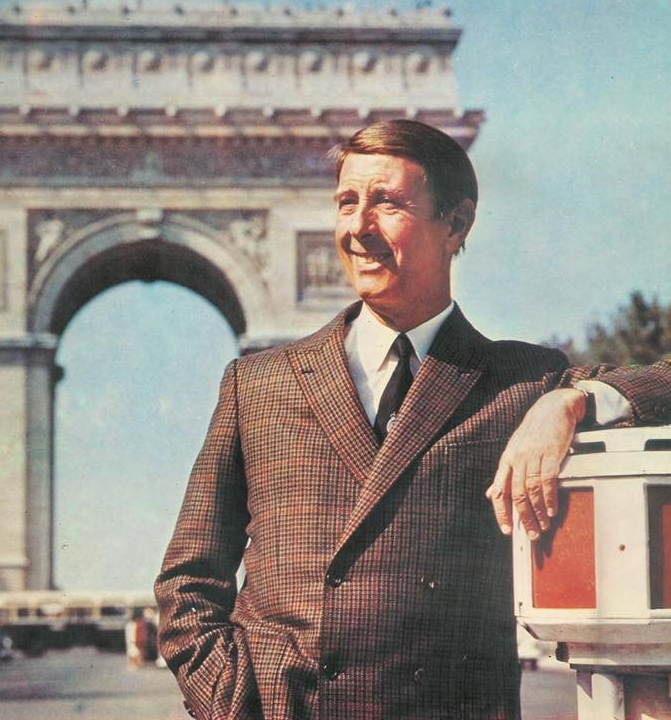
Saturday, 25 March 1972

CHARLES CAMILLERI

Born: September 7th, 1931, Ħamrun (Malta)
Died: January 3rd, 2009, Naxxar (Malta)
Nationality: Maltese

In due course, the short impression below will be replaced with a more extensive career overview


BIOGRAPHY

In 1949, Charles Camilleri moved with his father and the rest of his family to Australia; before that, he had already started music studies and aged twelve, he had performed as an accordion soloist with a forty-man orchestra. In the 1950s, Camilleri was one of the world’s most beloved accordionists. During his professional life, Camilleri lived in different countries: Canada, Great Britain, and the USA. He became an internationally acclaimed composer of classical works, including the ‘Malta Suite’ and the oratorio ‘Pawla ta’ Malta’; he also wrote entire operas in the Maltese language. His piano piece ‘Cantilena’ is part of the Grade 5 Trinity Guildhall Syllabus for piano students.

EUROVISION SONG CONTEST

In 1972, Charles Camilleri composed the second Maltese entry to the Eurovision Song Contest, ‘L-imħabba’, sung by Helen & Joseph. The lyrics were by Albert Cassola. Camilleri himself conducted the BBC Orchestra in Edinburgh during the rendition of this Maltese entry. Like the year before, Malta came last.

EUROVISION INVOLVEMENT YEAR BY YEAR

Country – Malta
Song title – "L-imħabba"
Rendition – Helen Micallef & Joseph Cutajar
Lyrics – Albert Cassola
Composition – Charles Camilleri
Studio arrangement – Pete Moore
Live orchestration – Pete Moore
Conductor – Charles Camilleri
Score – 18th place (48 votes)

JEAN-PIERRE FESTI

Born: July 7th, 1936, Marseilles (France)
Died: November 20th, 1976, Remoulins (France)
Nationality: French

In due course, the short impression below will be replaced with a more extensive career overview


BIOGRAPHY

Always together with his writing partner Yvon Ouazana, Jean-Pierre Festi (pseudonym of Jean Festinesi) composed and arranged songs for various artists in the late 1960s and early 1970s, including Johnny Hallyday, Jean Vallée, Rika Zaraï, Annie Cordy, Mary Roos, and Gigliola Cinquetti. Jean-Pierre Festi passed away at the age of 40 in 1976.

EUROVISION SONG CONTEST

Jean-Pierre Festi and Yvon Ouazana arranged the Swiss entry to the 1972 Eurovision Song Contest, ‘La chanson de mon amour’, composed and performed by Véronique Müller. Festi conducted the orchestra for her in Edinburgh, where Müller came eight among eighteen competing acts.

EUROVISION INVOLVEMENT YEAR BY YEAR

Country – Switzerland
Song title – "C’est la chanson de mon amour"
Rendition – Véronique Müller
Lyrics – Cathérine Desage
Composition – Véronique Müller
Studio arrangement – Jean-Pierre Festi / Yvon Ouazana
Live orchestration – Jean-Pierre Festi / Yvon Ouazana
Conductor – Jean-Pierre Festi
Score – 8th place (88 votes)

RICHARD HILL

The following article is an overview of the career of British composer, arranger, and conductor Richard Hill. The main source of information is an interview with Mr Hill, conducted by Bas Tukker in Hallow, Worcestershire, March 2017. The article is subdivided into two main parts; a general career overview (part 3) and a part dedicated to Richard Hill's Eurovision involvement (part 4).

All material below: © Bas Tukker / 2017


Contents
  1. Passport
  2. Short Eurovision record
  3. Biography
  4. Eurovision Song Contest
  5. Other artists about Richard Hill
  6. Eurovision involvement year by year
  7. Sources & links
PASSPORT

Born: August 22nd, 1942, Renfrew, Scotland (United Kingdom)
Died: June 13th, 2026, Worcester, England (United Kingdom)
Nationality: British

SHORT EUROVISION RECORD

Richard Hill is one of several British studio arrangers in Eurovision history called upon by another country’s broadcaster to conduct their festival entry. In 1972, the Portuguese Eurovision selection show was won by ‘A festa da vida’, a composition by José Calvário performed by Carlos Mendes. Having written the orchestration to the song, Richard Hill conducted the item in the pre-selection in Lisbon as well as in that year’s festival final, held in Edinburgh. In the international field, this Portuguese entry managed a seventh place.

BIOGRAPHY

Richard Vincent Hill was born during World War II in Renfrew, a town just west of Glasgow, where his father worked as a businessman. Though born in Scotland, Hill does not consider himself Scottish. 

“My father and mother both originated from England. When I was four or five years old, our family moved back south of the border, first to Manchester and later to London, where I grew up. Before the war, my father had been a playwright, working at Leeds Playhouse. Due to a leg injury, he didn't see any fighting during the war, joining the Home Guard instead. In London, after the war, he worked as a credit controller… which he didn't really like, but that is what he did to make a living."

"I think of myself as a Londoner, absolutely. Our house was in Mitcham, South London. I attended Mitcham County Grammar School for Boys. There were plenty of opportunities to play music and the school’s piano teacher was really good. With some friends, I formed a little jazz band in which I played the cello. Believe it or not, I managed to break the cello during a performance. The school were brilliant about it, though, and bought a double-bass as a replacement… I could not break that!”

Young Richard as a pupil at the Greenwood Road Primary School, Mitcham-London (1948)

Although he enjoyed playing, it was not on Richard’s mind to pursue a career as a musician yet. “The main passion during my teenage years was rugby. I also was pretty good at athletics and cricket, but in those days you could not do any of that professionally. I considered going to university to study volcanology, but bearing in mind that I was awful at science, that would have been a disaster."

"Who knows what I would have been if I had not passed a junk shop one day? That was where I saw an old trombone. I was seventeen years old and had one year of grammar school to go. That trombone saved my life. I could play the thing right away… the first tune that came out was ‘You Are My Sunshine’. I decided to take lessons; my teacher was Victor Saywell, a euphonium player with the Scots Guards. He taught me the trombone, but he taught me to play it almost as a euphonium, which is a very agile instrument, so I got really quick at it! By the time I graduated from school in 1960, I knew I wanted to try in music, and, though my parents were not really keen, I decided to apply for a scholarship at the Royal College of Music.”

With just eleven months of practice on the trombone, Richard did an audition at the renowned London conservatoire. “Among other things, the test consisted of playing the whole of Rimski-Korsakov’s 'Concerto for Trombone' and some of the Bach 'Unaccompanied Cello Suites' as well. At the end, the jurors asked how long I had been playing. When I told them that it had been no longer than eleven months, I saw some jaws drop. One week later, I received a letter saying I had won a scholarship. I was delighted, but things nearly ended in disaster. Just after the audition, I played in a county trial rugby match. Somebody put in a straight-arm tackle at me, splitting my lip and breaking some teeth… and in a few weeks I had to go to the Royal College of Music! It was troublesome and some dental work had to be done, but luckily it turned out not to have ruined my embouchure.”

Richard was a student at the Royal College of Music (RCM) for three years (1960-63), studying the trombone with Morris Smith; other teachers of his included Millicent Silver (piano, harpsichord), Philip Cannon (composition), and the renowned Sir Adrian Boult (conducting), under whom Hill became Principal Trombone in the RCM Symphony Orchestra. When asked about the most influential of his teachers, Hill does not hesitate for one moment. 

Richard as a 15-year-old playing bass in the Modern Dance Quintet (1957)

“That would have to be Adrian Boult. Above all others, this man still affects me and my attitude to music! First and foremost, he was a magnificent conductor. His minimalistic technique, based on the baton rather than big arm gestures, goes back to the days of Holst and Elgar, who, incidentally, were both trombone players at the RCM. Apart from that, he was the ultimate gentleman… a man from a different era."

"I remember one time, when I played in an orchestra which he conducted. During the concert, in which we played Bartok’s Concerto for Orchestra, I made a terrible mistake. Towards the end of the piece, there is a big pause in which the entire orchestra stops playing, but I misread my part and, being a bar out, I played out ever so loudly. Obviously, I was embarrassed; after the performance, I went out of my way to apologize to Sir Adrian, but he replied, “Never mind, Hill… if you are going to do it, do it nice and loud”. So there you are; this man was the complete opposite of the authoritarian school of conductors – no ‘screaming skull’, no Georg Solti. As a student, I had no idea yet that I would be doing a great deal of conducting during my career; also in that respect, Boult influenced me in a profound way. His handbook on conducting certainly was an invaluable help to me later on.”

During his student days, Richard Hill enthusiastically immersed himself in freelance work, playing the trombone as a deputy in several classical orchestras, including the Orchestra of the Royal Opera House and the Philharmonia Orchestra. Besides, being interested in other styles of music as well, he regularly played in jazz clubs and even formed a rock band, The Voomins. With their ‘March of the Voomins’, the group had a modest radio hit.  

“We were a mad lot, but our Voomins project was actually quite successful. We were an instrumental band. I simply played the trombone. Our style hovered between blues and rock ‘n’ roll. A lot of our stuff was taken up by big band programmes which were broadcast on radio around lunchtime. One of the big national papers, the Daily Mail, wrote a feature article about us, including some big pictures. This did not go unnoticed at the RCM. I got summoned to appear before the director and he really told me off. These were the days when they would not even admit guitar lessons being taught at the academy. I also remember Malcolm Sargent, a replacement conducting teacher, who came waltzing up to me and another trombone player, who were practicing some of our jazz tunes during the interval of a rehearsal. We were due to play in a jazz club that night. “What are you doing playing like that?”, he shouted, “This will ruin your tone!” That, in a nutshell, was the attitude to jazz, rock, and pop at the academy in the early 1960s.”

Richard (left) practicing at the Royal College of Music with fellow trombone student John Simcock (c. 1961)

In 1963, Richard Hill decided to leave the conservatoire, though he had been offered an extra year’s scholarship to obtain his diploma. His teachers were dismayed. On Richard’s last report in July 1963, Morris Smith wrote about his student’s progress on the trombone, “Excellent results in every way on his instrument; I feel he has all the ability to be an outstanding instrumentalist. Always plays with a sensitive musical feeling.” And Phillip Cannon about his talents in music theory, “A very lively mind with an original approach. A most sensitive and promising musician in every way.” 

“My teachers would have liked me to stay," Richard comments, "but, not unlike Captain Kirk in Star Trek, I wanted to be captain of my own spaceship. I kind of felt locked in at the academy. Instead of one more year of theory, I wanted to leap into the big wide world. As a freelance musician, I was already making a decent living. All kinds of things were happening in London. My best week would be playing at the Royal Opera House one night, going to a club the next evening with a jazz band; and a studio session playing some rock ‘n’ roll tracks in between! In music, I am an omnivore. As I liked doing many different things, it was not an option for me to join a classical orchestra as a regular player. I would have got jumpy about playing the same concerts year after year.”

Amongst many other gigs, Richard played the trombone in the orchestra which accompanied the Duke Ellington version of the Shakespeare play Timon Of Athens, which ran for several weeks at the 1964 Chichester Festival Theatre. 

“That was a great experience. The orchestra was conducted by Billy Strayhorn, Ellington’s band arranger. It was interesting to be so close to someone from the world of jazz for whom I had great admiration… I think Ellington’s version of the ‘Nutcracker Suite’ is a good as Tchaikovsky’s original, I really do! Jazz music has always been an inspiration to me. That is why I joined up with Dave Keir’s Jazz Band for a while in that period."

Richard (with trombone, middle) and his rock band The Voomins featuring in a music magazine (c. 1964)

"I also remember something else happening to me around the same time which was straight out of a movie. I sat at Marylebone Station in London, waiting for the train to take me home after an evening of work. It was around midnight. Suddenly, three coloured gentlemen leapt up who immediately noted my instrument case. “Hey man, playing trombone? We are the trombone section of the Count Basie Band!” So there we were, chatting for three quarters of an hour in the middle of the night about the differences between classical and jazz technique, about how they went to listen to classical orchestras to listen and learn. It was one of those episodes in your life that you never forget. It was fantastic. That was how inspirational London could be for a young musician in the 1960s.”

During his student days, Richard had become involved in renaissance brass music through the London Gabrieli Brass Ensemble, of which he was a founder member. In 1965, the eight-element-group released an album, ‘Royal Brass Music’. 

“It is a type of music which is seldom performed,” Richard explains. “That was the first reason why I was interested. The project got started in an unusual way. David Biddulph was a retired Royal Navy Lieutenant-commander. After his son, who was a trombone player, had been tragically killed in a motorcycle accident, David taught himself to play the instrument by way of honouring his lost child. He put up a notice in the Royal College of Music to find people who wanted to practice trombone quartets with him. John Simcock, Peter Harvey, and myself thought it was worth the while giving it a go."

"We found that Biddulph was a keen player – not a good sight-reader, but someone who did well as long as he learnt his part. His main talent, though, was presentation. So from the first time we played for an audience, he introduced the pieces we were playing and everybody loved the way he did that. That's how the Gabrieli Brass Ensemble was launched. Our first album came about by accident. With some of my fellow players, I was working as a session musician in the Pye Studio; while waiting for the recording to begin, we started playing some early music. The engineer, Bob Auger, was fascinated. This led straight to our first album, produced by Bob for Pye Records, which included music composed by King James I. It was even released in the US on the Nonesuch label. We were more successful with the Gabrieli than we could ever have imagined at the outset. It became a kind of livelihood thing.”


In 1965, Richard made a surprising career move; he signed as an artist & repertoire manager and studio arranger with Polydor Records, which was at that time a new record company in the UK, owned by Deutsche Grammophon. 

When asked about this turn of his career, Hill explains, “During the sessions of ‘Royal Brass Music’, again in Pye Studios, I had written a little instrumental pop piece, ‘Angel cake’. We made a recording of it, but just for fun – to have a short break from the baroque music we were working on. I never thought anymore about it, but the demo found its way to the desk of Ronald Rennie, managing director at Polydor Records. While off on tour with the Gabrieli in Cornwall, I got a phone call from him. “I like your single… now would you be interested in a job?” “What do you mean?” “Well, as an A&R man!” I did not even know what A&R meant, but I said yes and came to his office for a chat. We got on very well. So there I was all of a sudden with a fulltime job at Polydor!"

"I must say Ronald Rennie came along at the right time. It was a lot of fun touring, but I do not think I could have been a freelance player for much longer. After all, where did it lead? For me, Polydor meant a steady job and a way of getting into the studio world. The first session I did with Polydor was the first time I sat in a control room. I heard this great big sound coming out in stereo. It turned me onto recording, and it is something I have loved doing ever since. Polydor was a small company. Our offices were in Barrett Street above a shop; there were just seven or eight people working there. One of them was the personal assistant to the Head of A&R; her name was Liz. We fell in love and got married later on. One of the nicest things about Polydor was the artistic freedom. I could do pretty much whatever I liked, be it in classical or in pop music.”

At Polydor, Hill immersed himself in arranging work for, amongst many other artists, Roy Hudd, Jack Hammer, Bill Oddie, Ottilie Patterson, and fledgling Dutch band The Golden Earrings. Moreover, he also orchestrated songs for several French-market artists, including Johnny Hallyday. 

Conducting a session of the ‘Canterbury Pilgrims’ concept album: Pye Studios, London (1967)

“The Hallyday album in 1965 must have been my first-ever arranging commission. At the time, there was a musicians’ strike in France and all artists came over here to record their work. I had never written an arrangement, so it was a real baptism of fire – but it turned out well. Shortly after I was asked to do an album with Jack Hammer; he was the composer of ‘Great Balls Of Fire’ and really great fun to hang around with. It must have been the first occasion where I could prove myself as a producer in my own right. As Polydor did not have studios of their own, I recorded most of the stuff I did at Pye Studios, which became a second home for me."

As an A&R man, Hill stumbled upon Fab Cab, an a cappella group comprised of Cambridge University students, led by Marcus Bicknell. In 1967, he renamed the group The Gentle Power of Song and recorded an album with them, called ‘Circus’. 

“When I first heard them, I thought about how great it would be to let them sing in the style of the Beach Boys. Ronald Rennie liked the idea – we were given a generous budget and so we went into the studio. I did two LPs with them; ‘Circus’ was in pop style and the second one, released one year later, a Christmas album called 'Peace' with religious songs in baroque style. Of course, though we sold quite a lot of records, projects like these were no million sellers, but to be honest – I was not in it to be in the charts."

"The only real hit in these years which I remember being involved in was ‘This Wheel’s On Fire’ (by Julie Driscoll, Brian Auger & The Trinity: 1968 – BT). Bob Dylan had written a song for Julie and had recorded it as a demo. Julie and Brian were actually produced by Giorgio Gomelsky, but Giorgio asked me to be at the studio recording with him. Gomelsky was a great guy, but this particular session was an outright disaster. The band and Giorgio were trying to play the song in a hundred different ways – and none of them worked. All I did was keep on saying, “Look, why don’t you record it the way Bob Dylan had sung it on the demo. Just simple, straight – copy that, and you'll be all right.” Finally, they did just that… and it did work, but by then it must have been three o’clock in the morning. Liz and I went home being fed up with how they could not see how simple it was.”

The Israeli single release of ‘This Wheel’s on Fire’ by Julie Driscoll, Brian Auger & The Trinity (1968); Richard Hill co-produced the studio session for this record with Giorgio Gomelsky

Meanwhile, Richard also accepted the occasional freelance orchestrating job; amongst other commissions, he worked for BBC’s Top of the Pops, writing arrangements to tunes sung by the likes of Aretha Franklin and Nina Simone. Due to his extensive studio work, there was less and less time to join up with the Gabrieli Brass Ensemble. 

“My fascination for renaissance and baroque music was still there, though. That's why I suggested to Ronald Rennie to do a concept album about Chaucer’s ‘Canterbury Tales’, a book which I had really enjoyed reading at school. Why not adapt the work and write music to it; a narrated prologue and descriptions of the different characters, all with music behind? I was sure the Gabrieli’s trademark brass sound would be ideally suited to recreate a Medieval feel. Again, Rennie said, “Just go and do it!”, and that's what I did."

"As a rookie, I had not done too much composing and arranging yet. Therefore, I asked John Hawkins, an experienced journeyman arranger who had helped me out brilliantly on the Jack Hammer album; and good fun to be with. Together, we conceived the music and arrangements based on my initial idea. We got Professor Nevill Coghill from Oxford University on board to adapt Chaucer’s words to fit into our concept, and Martin Starkie as the narrator. All music was played by the Gabrieli and the result pleased us all. The album was released in 1967. It did well and was even nominated for a Grammy for Best Spoken Word Album, only to be beaten by the recorded speeches of the late President Kennedy!”

One thing led to another – and eventually it was decided to make an attempt at turning the concept album into a musical stage version. Once again, Richard teamed up with John Hawkins to rewrite the music. All in all, the musical consisted of nineteen songs. 

“From the outset, we decided to divide the writing work evenly between the two of us. So each of us came up with a set of songs. The arrangements were also split up. All of that had to fit a certain sound which I had in mind, which was the Gabrieli Brass Ensemble with a rock rhythm section, without any strings. Again, I wanted to convey a Medieval atmosphere. Nevill Coghill was really quite unsure about how to turn Chaucer into pop songs, but it worked out fine – John and I just let the music flow from his lyrics.”

Richard (left) with Martin Starkie working on the score of the musical version of ‘Canterbury Tales’ (1968)

For the stage version of Canterbury Tales, which premiered in the Phoenix Theatre on London’s West End in March 1968, Vlado Habunek and Martin Starkie took care of the directing job. The main actors were Wilfred Brambell, Hugh Manning, and Pamela Charles.

 “… and the whole thing ran for five-and-a-half years,” Richard laughs. “We never expected that, because, unlike Hair and Jesus Christ Superstar, Canterbury Tales was never a play which was going to produce a hit song. What it succeeded in, though, was bringing the fourteenth century to life. There was this Medieval book which was on every English literature curriculum, and our theatre production managed to take it out of the classroom. The purpose was in part educational and many schools came with their pupils to watch the musical. Many American tourists came to attend performances as well. For the Gabrieli Brass Ensemble, it meant having a steady job for years on end. The conducting job was divided amongst several people. John Hawkins and I shared it for the first six months, and then there were one or two others. It would have been impossible to have one person conduct the same pieces over 2,000 times.”

Incredibly, between 1968 and 1973, ‘Canterbury Tales’ was performed 2,080 times in the West End. In 1969, the play was also staged at Broadway. In New York, however, the musical did not nearly do as well as in England, being performed 121 times over the course of three months. However it did enjoy two very successful US tours. Later, the play was successfully produced in many other countries, most notably South-Africa, Australia, and West-Germany. Hill was involved in most of these productions as a conductor. After the end of the UK production, the London Gabrieli Brass Ensemble went on an international tour which brought them to the United States and many European countries. Moreover, they recorded several more albums, co-conceived, produced, and arranged by Richard Hill, such as ‘The Four Elements’ (1970) and ‘Band Of Gold’ (1971).

In 1971, Richard left Polydor, joining ATV Music as a writer, arranger, and conductor. ATV Music was the music publishing arm of Associated Television, an independent UK broadcaster specializing in variety and light entertainment. He stayed with the company until its demise in 1982, upon which he joined one of its successors, TVS (Television South) for some more years. In the course of the 1970s and early 1980s, he composed the music to such TV films as To Kill A Clown and Baffled!, as well as the trilogy Clayhanger and further drama series including Will Shakespeare and Sounding Brass.

On the set of ATV drama series ‘Will Shakespeare’ – Globe Theatre, London (1978)

“After six years at Polydor, it was perhaps simply time to move on. Geoff Heath, the director at ATV, was a former school classmate of mine and he invited me to join them. Working at ATV gave me the opportunity to explore a different corner of the music business; I wrote dozens of theme tunes and got access to all these films and drama series."

"As the composer of the music for a film or series, I was always booked as a music advisor as well, which meant I went on location and helped to sort out props for any instrument. In the case of ‘Sounding brass’, I taught the actors how to mime playing their instruments properly. Brian Glover was the actor who played the role of the brass band’s conductor. In the film, he had to conduct Tchaikovsky’s ‘1812 Overture’. On the location where that scene was recorded, there were all these huge, half-open concrete pipes. This gave me the opportunity to hide from the cameras inside one of those pipes whilst conducting the ‘1812 Overture’ to the recording to which the band of actors were miming their performance. All Brian had to do, was following my gestures. It must have been an hilarious sight to see this mad bloke with a baton conducting Tchaikovsky in a concrete pipe, but Brian’s performance in the film worked out well – and that was the main thing!"

"Having said that, you can get fed up with writing drama series music… and after some ten years, I did. You are not making any decisions on your own, instead having to make yourself subservient to the wishes of the director or production team.”

Though under contract with ATV and later TVS, Richard Hill also worked as a composer in his own right. As such, he released several solo albums, the first one being ‘Toad Of Toad Hall’, a short audio drama put to music, in 1969; nine years later, he came up with ‘Chanctonbury Ring’, which was in the prog rock genre. Moreover, Hill composed quite a lot of so-called library music, recorded music available to customers for use in film, advertisements, or other media. Away from that, he continued being in regular demand for studio work as an arranger and producer, teaming up with the likes of John Cleese, Don Lusher, Elkie Brooks, Dana, Bill Oddie, and Duncan McKay. He penned the Sarah Brightman disco single ‘The adventures of the Love Crusader’ and took care of the choral arrangement on Paul McCartney’s 1983 number-one-hit success ‘Pipes Of Peace’. 

Conducting the Großes Rundfunk-Orchester Berlin for a performance with the Chris Barber Jazz Band in East Berlin's Palace of the Republic (1986)

“That was with the Choir of Pestalozzi International Children’s Village. I did an album with the children of Pestalozzi called ‘Songs of joy’, which got on television and did quite well. Paul McCartney heard it and was keen to do a single with them. As for Sarah Brightman; well, to be honest, I fabricated that song for the money. It made the charts, but I got so bloody bored by it.”

Over the years, Richard Hill had come to prefer working as a ‘backroom boy’ in the studio to performing on stage, but he made an exception for the Amazing Catsfield Steamers, a Sussex-based folk group in which he played the trombone for some years. In 1983, he was the producer of their album ‘United friends’. Also in the 1980s, Hill did countless stage performances in the UK, but mainly abroad with the Chris Barber Jazz Band and various symphony orchestras around Europe. 

“Chris is an old friend of mine. Though he's much older than me, it was our mutual love for the trombone and jazz music which created a strong bond between the two of us. As a classically trained musician, I could teach him certain tricks on the trombone. Over the years, we had always stayed in touch. At some point, Chris wanted to try his hand at symphonic jazz, having his band accompanied by an orchestra – and that is where I came in. I wrote orchestrations of a wide range of jazz standards. Going on tour, we worked with local symphony orchestras, which I conducted. We performed in many cities all over Europe, including behind the Berlin Wall in East Germany. Thanks to my involvement in recording library music, I had become quite an experienced conductor… though all of this ultimately goes back to Adrian Boult, of course. I have always found it particularly enjoyable to conduct orchestras, as it gives you the opportunity as a conductor to make the orchestra give something more than just the score itself. Chris and I did a lot of concerts for quite some years.”

From the early 1990s onwards, Richard Hill has firmly focused attention on his own compositions once again. After having worked in light entertainment music for most of his career, he has now retraced his classical origins by writing several contemporary classical pieces, notably the music drama The Rime Of The Ancient Mariner (1994) and the orchestral ballet suite Images From Kubla Khan (1998), both based on the poetry of Samuel Taylor Coleridge. 

‘Images from Kubla Khan’ studio session with voice-over Ben Kingsley (1998)

“Originally, Images had been written specifically for East Germany’s Radio Orchestra, who I had got to know thanks to the Chris Barber concert tours in the 1980s. They were particularly keen to have music specifically written for them. The inspiration for Images was Rimski-Korsakov’s ‘Sheherazade’, so, though it qualifies as modern music, it is in no way avant-garde in its approach. We recorded it in 1989, but it was not until much later that the piece was released. As for The Rime Of The Ancient Mariner, thanks to Oxford University, who scraped together a budget, we were given the opportunity to perform it at the Edinburgh Festival in 1994. The music worked out really well and it got terrific reviews.”

Among Hill’s more recent projects are ‘Baroque sounds’, in which he plays baroque music on a synthesiser, a ‘Concerto for Trumpet’, and a dramatized oratorio based on the life of St Wulstan of Worcester. 

“I've never stopped writing music, especially music to poetry, creating musical soundscapes. For the Wulstan project, I worked with research assistance from tutors at Cambridge University. With classical music, it is impossible to reach the mass audiences in the way that pop productions or my musical Canterbury Tales have, but maybe I am not much of a careerist. After Canterbury Tales, I suppose I could have gone on making a living from theatre music, but I never gave it a thought. There was always a next project in another genre waiting for me somewhere. There are so many different things in music I like doing.” 

Or, as Richard put down his creed in a 1983 interview with the Hastings Observer, “I do not like specialising. I do so many bits and pieces [that] I lay myself open to being called a jack of all trades and a master of none. But I don't see why you cannot be a jack of all trades and a master of all.”

Close-up, March 2017

EUROVISION SONG CONTEST

Along with the likes of Colin Frechter and Martyn Ford, Richard Hill is a British musician who took part in the Eurovision Song Contest as a conductor for another country than the United Kingdom. In Richard Hill’s case, the country was Portugal, which in the 1970s regularly invited foreign arrangers to take part in their national selection programme, the so-called Festival RTP da Canção. Among others, Augusto Algueró from neighbouring Spain arranged Tonicha’s 1971 Eurovision entry ‘Menina’, while Algueró’s compatriot Rafael Ibarbia even conducted one of the entries in the 1974 Portuguese heats. 

In 1972, upon being approached by the Portuguese broadcaster RTP or a local record publisher for reasons which will probably forever remain lost in the clouded annals of Eurovision history, ATV Music, the UK publishing company to which Richard Hill was signed as a writer and conductor at the time, acquired the publishing rights to two entries for the Portuguese Eurovision selection show.

Digging deep into his memory, Richard Hill explains, “Len Beadle was the general manager of ATV Music at the time. He told me about these people from Portugal who were looking for arrangers and conductors for their Eurovision entries. “Would you fancy a few days in Lisbon to do the gig?”, Len asked. Well, yes, all right, why not? Len did one of the other entries (‘Cidade alheia’ performed by Duarte Mendes, for which Pedro Osório is credited as the arranger – BT), while I took care of ‘A festa da vida’. I do not remember a briefing for the orchestration with José Calvário, the composer, but there must have been a demo of some sort, recorded in Portugal, from which I did the proper arrangement. In those days, it was not unusual to be given commissions to do arrangements for recording projects directly from demos without meeting the composer or artist until the studio date.”

“Len and I turned up in Lisbon for the national selection television show as conductors; and ‘A festa da vida’ won it (by a landslide – BT). I didn't experience any problems in communicating with the Portuguese orchestra musicians. Using gestures and the odd bit of Italian, which is the language of music signs, did the trick. Later on, when I performed in East Germany and Bulgaria with Chris Barber, I did the same; conducting a rehearsal, basically, amounts to using the universal language of music, which any classical musician speaks."

"My memories of Lisbon? Well, it was actually little more than hotel room, rehearsal, hotel room, rehearsal, concert. I remember going for a short walk in the old town. It was obvious that Portugal was a poor country in those days. I happened to walk past a shop where coffins were sold – and the spooky thing was that most of these coffins were little ones. The death rate among children in Portugal must have been really high back then.”

Carlos Mendes congratulated on his first prize in the 1972 Festival RTP da Canção by the previous year's winner, Tonicha. The duo are flanked by composer José Calvário (left) and lyricist José Niza

As the arranger and conductor of the winning entry in the Festival da Canção, Richard Hill was a member of the Portuguese delegation to the 1972 Eurovision Song Contest, held in Edinburgh, Scotland. His wife Liz was there to accompany him. Did it feel strange doing Eurovision on home soil as the conductor for Portugal? 

“No, not really… I guess I had the attitude of a footballer; wherever you are signed as a player, you're paid to do your thing. Having said that, the whole of the Portuguese delegation treated us with great courtesy throughout the experience. José Calvário was the opposite of a rock ‘n’ roll icon; a polite guy who seemed well-educated and extremely professional – a delight to work with. Carlos Mendes was a nice guy too. I don't remember a language problem, so I guess both José and Carlos spoke English. The atmosphere was really good and there were no hiccups in rehearsals.”

Strikingly, Carlos Mendes was backed up by a choir of three girls in Edinburgh, although there had been only two in the heats in Lisbon. 

“It is unlikely that I wrote the background parts in Lisbon, simply because I would never write for only two singers. I prefer three, as it gives me a stronger timbre when in unison and more options when in harmony. This leads me to think that José must have written the vocal arrangements for the version we did in Lisbon, whilst I wrote new parts for the Eurovision final, possibly working together with José. I suspect the singers on stage behind Carlos in Edinburgh were local Scottish girls, but it is all very long ago… so I cannot be sure”.

Thinking back of his Eurovision experience, Richard recalls a witty moment which occurred during the last run-through of the contest. “I was in the front row of the auditorium watching what was going on on stage. While Malcolm Lockyer (the musical director of that year’s contest – BT) conducted the intro music with the orchestra in the pit, Moira Shearer, who was booked as the host of the evening, came waltzing onto the front of the podium, staring down at Malcolm who went on and on conducting away while she was becoming slightly impatient. After some time, he noticed her and, loud enough for us to hear, he simply said, “Oh, hello, Moira!” He was obviously supposed to know she was there, but apparently he was having a hazy moment.”

Carlos Mendes enjoying a moment of relaxation in the press room of Edinburgh's Usher Hall - Eurovision 1972

In the Eurovision Song Contest final in Edinburgh, Carlos Mendes and ‘A festa da vida’ did quite well, landing a seventh position – the best result Portugal had ever managed at the festival. 

“The performance was alright. When watching it on YouTube now, the only thing wrong with it is the sound; the three backing girls are too loud in the mix. The song itself was passionate and it has something quirky about it. It is in D-minor and its tempo doubles when the chorus starts. There are some hints of Portuguese folk music and it is certainly better than the usual Europop which has so often been performed on a Eurovision stage.”

"I don't recall much else of the contest - not even the winning song, though the name Vicky Leandros does ring a bell. All I can recall is making sure I remembered everything I needed to focus on to give my best performance with the orchestra.  In this regard it was similar to the attitude I was trained to adopt at the Royal College of Music, which served me well as a player on scary gigs like those at the Royal Opera House, the Philharmonia, conducting behind the Berlin Wall, and so on. Likewise, I don’t remember much of the aftermath of the show.  I’m sure I would have greeted Carlos and José and congratulated them on what I thought was an excellent performance of a really good song, but the details of an after-show party have escaped my memory. Who knows, maybe there’s a reason!"

The 1972 contest was to remain Richard Hill’s only-ever Eurovision involvement. “I could have tried, but I didn't have any ambition to make my mark as a songwriter or pose in front of a television orchestra and an audience. I was quite happy composing music for drama series and films back then."

"At ATV music, every year, they would announce that it was Eurovision time again, inviting their writers to submit songs for the competition. I never got into doing that, though I remember recording a couple of demos for Stephanie De Sykes, who was really keen to take part. Along with Madeline Bell, Steph was one of the most sought-after session singers of the day. Whatever became of her songs, I wasn't involved in writing the orchestrations later on."

Single release of ‘A festa da vida’ with a dedication by Richard Hill

"Perhaps over 40 years after the Eurovision Song Contest, when we had a reunion with the Gentle Power of Song group, who were all University of Cambridge alumni, Marcus Bignall got up and said, "Now you conducted Eurovision didn’t you?" They all start taking the mickey out of me. They're all academics, you know. It was all very good-natured; nothing mean about it, but I suppose you're aware what the general attitude towards Eurovision is in the UK."

"It was alright, because I'm not ashamed of having done Eurovision, especially because the song was good. I like that song. It's a bit deeper than your average Eurovision entry; but the contest in Edinburgh was just one gig; a one-off, so not very relevant for my CV. It would have been relevant if I had always wanted to be a conductor of television orchestras... which was not the case."

"I don’t watch Eurovision these days, except for clips which appear on TV as promotions before, and reviews after the event.  From those, it seems to me that a fundamental change has taken place in the contest.  Given my background, I like to believe that the first Eurovision Song Contest was perhaps Wagner’s ‘Die Meistersinger von Nürnberg’, with that wonderful prize song. From there we have come a long way, from modern populist theatrical dance drama to simply the judgement of the quality of a song – and of course, political issues now seem to be involved, which is a concern."

"The ditching of the orchestra was perhaps inevitable, as popular musical language has changed so much from the traditional presentation of a piece, to a broader overall hi-tech concept of entertainment, with all that entails in sound and light.  In that sense, and within this new genre, I’m sure Eurovision does indeed have a future. I suppose its popularity simply depends on how many multitudes watch it, and that seems to be secure for now.  The skill of orchestration is a casualty, but an inevitable one, I feel."

In recognition of his work on the 1972 Eurovision entry, Richard Hill received quite an original present from Portugal's broadcaster RTP - an ashtray bearing their logo

OTHER ARTISTS ABOUT RICHARD HILL

So far, we have not gathered memories of other artists about working with Richard Hill.

EUROVISION INVOLVEMENT YEAR BY YEAR

Country – Portugal
Song title – "A festa da vida"
Rendition – Carlos Mendes
Lyrics – José Niza
Composition – José Calvário
Studio arrangement – José Calvário / Richard Hill
Live orchestration – José Calvário / Richard Hill
Conductor – Richard Hill
Score – 7th place (90 votes)


SOURCES & LINKS
  • Bas Tukker interviewed Richard Hill in Hallow, Worcestershire, March 2017
  • All photos courtesy of Richard & Liz Hill, except for the 2017 close-up, which was taken by Bas Tukker
WEBSITE

AUGUSTO ALGUERÓ

Born: February 23rd, 1934, Barcelona (Spain)
Died: January 16th, 2011, Torremolinos (Spain)
Nationality: Spanish

In due course, the short impression below will be replaced with a more extensive career overview


BIOGRAPHY

Augusto Algueró started an academic study of medicine, but changed to the Conservatorio Municipal de Barcelona to become a professional musician. He composed popular songs (amongst which ‘Penélope’ for Joan Manuel Serrat) and more than 90 soundtracks for films for cinema and television from 1950 onwards. The TV programme Historias de la frivolidad, to which he had composed the music, won the 1967 Golden Rose of Montreux as well as the Golden Nymph of Monte Carlo. Two years later, the latter prize was again conferred upon a programme with a soundtrack by Algueró, El irreal Madrid. In 1998, Algueró received the American BMI Prize for ‘Penélope’ being the most interpreted song in Latin America of all times. In 1972, Algueró was the musical director of the first OTI Festival, held in Madrid; during this contest, he conducted the entries of Spain, Portugal (which was represented by Algueró’s protégé Tonicha), and Uruguay.

EUROVISION SONG CONTEST

In 1961, Algueró composed the music to Spain’s first-ever Eurovision entry, ‘Estando contigo’, which was sung by Conchita Bautista. In 1969, when the festival was organised in Madrid’s Royal Theatre, he was the musical director of the show, conducting two entries (Spain’s winning ‘Vivo cantando’ and Luxembourg’s entry, ‘Cathérine’). One year later, he accompanied Julio Iglesias to Amsterdam to conduct his Eurovision attempt ‘Gwendolyne’. In 1971, Algueró was not present at the contest, but he had arranged the music to the Portuguese entry, ‘Menina’ by Tonicha. One year later, finally, he composed, arranged, and conducted Spain’s entry ‘Amanece’ (with lyrics by Ramón Arcusa), which was sung by Jaime Morey.

EUROVISION INVOLVEMENT YEAR BY YEAR

Country – Spain
Song title – "Estando contigo"
Rendition – Conchita Bautista 
Lyrics – Antonio Guijarro
Composition – Augusto Algueró
Studio arrangement – Augusto Algueró
(Orquesta Toreador conducted by Augusto Algueró)
Live orchestration – Augusto Algueró
Conductor – Rafael Ferrer
Score – 9th place (8 votes)

Country – Spain
Song title – "Vivo cantando"
Rendition – Salomé 
Lyrics – Aniano Alcalde
Composition – Maria José de Cerato
Studio arrangement – Joan Barcons
Live orchestration – Joan Barcons
Conductor – Augusto Algueró (MD)
Score – 1st place (18 votes)

Country – Luxembourg
Song title – Cathérine
Rendition – Romuald Figuier
Lyrics – André Pascal
Composition – André Borly / Paul Mauriat
Studio arrangement – André Borly
Live orchestration – André Borly
Conductor – Augusto Algueró (MD)
Score – 11th place (7 votes)

Country – Spain
Song title – "Gwendolyne"
Rendition – Julio Iglesias
Lyrics – Julio Iglesias
Composition – Julio Iglesias
Studio arrangement – Benito Lauret
(studio orchestra conducted by Ivor Raymonde)
Live orchestration – Benito Lauret
Conductor – Augusto Algueró
Score – 4th place (8 votes)

Country – Portugal
Song title – "Menina (Do alto da serra)"
Rendition – Tonicha
Lyrics – José Carlos Ary dos Santos
Composition – Nuno Nazareth Fernandes
Studio arrangement – Augusto Algueró
(studio orchestra conducted by Augusto Algueró)
Live orchestration – Augusto Algueró
Conductor – Jorge Costa Pinto
Score – 9th place (83 votes)

Country – Spain
Song title – "Amanece"
Rendition – Jaime Morey
Lyrics – Ramón Arcusa
Composition – Augusto Algueró
Studio arrangement – Augusto Algueró
Live orchestration – Augusto Algueró
Conductor – Augusto Algueró
Score – 10th place (83 votes)

FRANCK POURCEL

The following article is an overview of the career of French violinist, composer, arranger, and conductor Franck Pourcel. Interview fragments were retrieved from various sources, listed at the bottom of this write-up. The article below is subdivided into two main parts; a general career overview (part 3) and a part dedicated to Franck Pourcel's Eurovision involvement (part 4).

All material below: © Bas Tukker / 2020


Contents
  1. Passport
  2. Short Eurovision record
  3. Biography
  4. Eurovision Song Contest
  5. Other artists about Franck Pourcel
  6. Eurovision involvement year by year
  7. Sources & links
PASSPORT

Born: August 11th, 1913, Marseilles (France)
Died: November 12th, 2000, Neuilly-sur-Seine, Greater Paris (France)
Nationality: French

SHORT EUROVISION RECORD

One of the best-known conductors in the history of the Eurovision Song Contest, Franck Pourcel was commissioned by broadcaster RTF (later ORTF) year after year to accompany the French contestants in the festival from 1956 until 1972, with the exception of the editions of 1957 and 1968. On four occasions, Pourcel was part of the winning Eurovision team; with André Claveau (1958), Jacqueline Boyer (1960), Isabelle Aubret (1962), and lastly Frida Boccara (1969). For the Eurovision editions of 1959 and 1961, both held in Cannes, Franck Pourcel was the musical director – and, as such, he jumped in for a number of entries of foreign broadcasters who did not bring their own conductor. In total, Franck Pourcel led the orchestra for 23 different Eurovision songs from 6 different countries.

BIOGRAPHY

Franck Louis Marius Pourcel was born in 1913, just yards away from the Old Port of Marseilles. His father descended from Italian emigrants who had flocked to Southern France in large numbers in the course of the 19th century. Professionally, father Pourcel, who named his son after Belgian classical composer César Franck, was a senior engineer in the French Navy, but he also played in an amateur orchestra of which all members worked for the maritime forces. At six years of age, Franck was taught the first principles of solfege by his father, upon which he took up violin lessons – and quite soon, it was obvious the young man had talent. He was sent to Marseilles’ local conservatoire, where he won first prize as a violinist in 1929.

As a teenager, in order to assemble the money required for his studies, Franck Pourcel played jazz music in cabarets in downtown Marseilles. “Already during my student days in the 1920s, there were quite a lot of jazz men in Marseilles, especially among students, and with some friends I founded a small jazz orchestra," Pourcel once explained. "To be hired by cabarets or for gala evenings, musicians had to be able to play at least two musical instruments. Most violinists chose the saxophone as their second instrument, but I didn’t, because somehow playing the saxophone badly interfered with my perfect pitch – and therefore I picked the drums instead. How I learnt to play them? A local stonemason who played the drums in his free hours taught me the basics!”

Franck and his wife Odette in the streets of Marseilles (1939)

Upon graduating in Marseilles, Franck Pourcel moved to Paris for an additional year of studies (1929-30). In the following year, he accomplished his military service. Returning to his native town, he took up working as a violinist in the Théâtre des Variétés, where his uncle was the general manager. In this theatre, he mainly accompanied revue artists; the renowned Fernandel was one. When the theatre closed down, he continued his career at the Marseilles Opera Orchestra, whilst earning some valuable extra money as a drummer in nightclubs during the late evening hours.

“As a young musician,” Pourcel recalls, “my dream was to become a famous violin soloist, but after completing my studies and my year in the army, I had little choice. I had to work in order to make a living. That is why I played in theatres and nightclubs; having said that, I really loved jazz music, which made a welcome change from the operatic performances. After two years at the Marseilles Opera, I quit – mainly because I wanted to progress as a musician and earn a better salary. For that reason, I asked Paul Bastide, the manager of the opera house, to let me go. In the following months, I played the violin in the orchestra of Cinema Odéon. Our job was to accompany the artists who performed the interval act. Around that time, I met Yves Montand. In 1941, Montand was looking for a kapellmeister. His impresario Émile Audiffred then asked me if I were interested to conduct a revue with Montand as the main artist. Of course I was, and I accompanied this revue for about a year.”

In 1942, Yves Montand was forced to temporarily cease his professional activities when he was called up for the Vichy Regime’s paramilitary training. Pourcel did not have to wait long for a new challenge, however, as, one year previously, he had met the singing couple of Lucienne Boyer and Jacques Pills, just at a moment when Lucienne was looking for a violinist for her performances. After signing a first contract for three months, Pourcel stayed with Boyer and Pills for the next eight years, touring and recording several songs in the Parisian record studios. The sessions with Lucienne Boyer in 1943 most probably were Pourcel’s first stint at record arranging.

Accompanying Lucienne Boyer on the violin (1942)

“In the last years of the war, I mainly toured with Lucienne Boyer, playing in gala performances across Southern France. After France was liberated in 1944, I formed a combo of musicians with which Lucienne and Jacques went on a one-year-long international tour across the world. We performed in Scandinavia, the United States, Canada, even Brazil and Argentina. It was a fantastic experience! In Ottawa, the manager of the auditorium where we were due to play explained us that protocol stipulated to finish the performance with the UK national anthem. As best we could, we played the ‘God Save the King’, for which I had slightly changed the musical bridge towards the end of the piece – and the audience reacted very well to that.”

In 1945, Pourcel arranged Boyer’s hit recording ‘Mon cœur est un violon’, for which he took care of the essential violin parts himself. In the latter half of the 1940s, apart from touring with Lucienne Boyer and Jacques Pills, Franck Pourcel wrote record arrangements for Maria Vincent, Reda Caire and the duo Gaby Verlor & Jean Davril. In 1949, he met producer Maurice Tézé, who was particularly impressed by Pourcel’s arrangements and wanted to sign him for his record company Selmer. Pourcel, however, had dreams of his own.

“After the war, I discovered the recordings of American conductors such as Morton Gould who played popular music with a grand orchestra. Henceforth, my dream was to form a similar orchestra in France. Frankly, though, the French weren’t ready for that. No matter which record company I turned to, they weren’t interested. At that time, creating an orchestra with 50 musicians sounded nuts, but I wanted it. Maurice Tézé, however, who originally wanted to sign me to do record arrangements for his artists, seemed vaguely interested. He asked me to wait until he had brought together the money for a recording session with a large studio orchestra. Obviously, I didn’t want to wait and took my wife and daughter with me to New York in 1950, and again in 1952, to see if I could realise my ambitions in the United States. In 1952, I had more or less given up on Tézé – and I was prepared to stay in America for good.”

In New York with Odette and their daughter Françoise (1951)

In New York, Pourcel obtained a member card of the American Union of Musicians, but he had to content himself with the odd job here and there as a violinist. In between his two stays in America, he led the orchestra in the casino of Enghien-les-Bains, Greater Paris. In Enghien, he first worked with pianist Paul Mauriat, who, like Pourcel, was from Marseilles. At long last, in the spring of 1952, while in New York, Franck received a telegram from Maurice Tézé which read, “It is there! I have finally brought together some money to pay for a session with a grand orchestra. Return to France instantly to record the music you want with the orchestra you want!” As he actually wasn’t thinking any longer of making a career in France, Pourcel first consulted a fortune-teller about which choice to make – and he received the advice to head back to Europe, which he duly did. Once in Paris, the first instrumental piece Pourcel recorded was ‘Tango bleu’, a cover version of a chart success from the United States.

“My wife Odette loved that song,” Franck explains, “and though I wasn’t particularly fond of it myself, I chose it for my first recording. Maurice Tézé promised me a session with forty to fifty musicians, including a huge number of violinists. Finally, my dream came true! The session was done in the Schola Cantorum Music School in Paris and most of the musicians were recruited from the Opera de Paris Orchestra. From the moment that first record was released, my name was on the lips of radio presenters and listeners across France. People were assuming I was American – and anything foreign, especially from the United States, a priori sounded better than a French recording. It was like honey to the bees! Franck Pourcel… it was a name with a ring to it. If my name had been Marius Pourcel, I am sure I would not have succeeded. From this moment, my career was off. This record and its follow ups reached incredible selling figures.”

Some titles included on Pourcel’s next single releases were ‘Limelight’ and ‘Moulin rouge’. In 1953, a first LP was released, ‘Danses sélection’, with fourteen instrumental pieces in the newly invented Pourcel style, a string-based easy listening sound. Shortly thereafter, after Maurice Tézé had left Selmer Records and joined Pathé-Marconi, the French branch of His Master’s Voice, Pourcel joined the producer who had given him the opportunity he had been looking for for so long. Pourcel’s first record at Pathé-Marconi, an LP with ten instrumental pieces, was given the title ‘Amour, danse et violons’.

At work in the recording studio with actress/singer Danièle Darrieux (1958)

It was the start of a series of 54 (!) albums released across the world over the course of the following twenty-seven years (1953-80), each containing a mix of current chart successes, folk melodies, film music, and dance tunes given the trademark Frank Pourcel makeover, rich with violins – the instrument which, according to Pourcel, was closest to the human voice and therefore the instrument which speaks to the heart of man. Being a perfectionist, Pourcel, even though between two and four ‘Amour, danse et violons’ albums saw the daylight each year, was accurately involved in every detail, from the sound edit to even the record cover. While he initially wrote all orchestrations himself, Pourcel, forced by a lack of time, later allowed some of the writing work to be taken care of collaborators such as Raymond Lefèvre. ‘Amour, danse et violons’ was a hugely successful concept, copied afterwards by countless arrangers across the world, first and foremost Pourcel’s pianists Paul Mauriat and Raymond Lefèvre.

Meanwhile, in the 1950s, parallel with his solo records, Franck Pourcel became one of his country’s most sought-after record arrangers. In 1952, he wrote the orchestration to Charles Aznavour’s first success ‘Jezebel’. Moreover, he also made studio recordings with, amongst many others, Gilbert Bécaud, Jean-Claude Pascal, Charles Trenet, Mathé Altéry, André Claveau, Danièle Dupré and Tino Rossi. Pourcel’s most lasting connection, however, was with Spanish-born songstress Gloria Lasso, one of the many discoveries of Maurice Tézé. Her signature hit ‘L’étranger au paradis’ (1955), which sold one million copies, was arranged by Pourcel.

“The first recording I did of that song was with a combo of 5 musicians,” Pourcel recalls. “One evening, around midnight, Maurice Tézé called me to tell that the selling figures of that record were going through the roof, and that Pathé-Marconi would like me to do a re-recording with a grand orchestra to add some cachet to the song. Thereupon, we travelled to Milan for a second session of ‘L’étranger au paradis’ in a church. Unfortunately, as Gloria was feeling exhausted, she was unable to sing the very last note. As my train for Paris was about to leave, I had no other option but to end the session without recording the entire piece – and we recorded that last note with a completely different session orchestra in Paris! In spite of all efforts, the original quintet version has always remained more popular. To my mind, Gloria Lasso was one of the most talented vocalists of her generation."

Conducting a television orchestra (1959)

"Toward the end of the 1950s, as I was progressively absorbed by my ‘Amour, danse et violons’ albums, I decided to more or less stop writing accompanying arrangements for recording artists. I left Gloria Lasso in the very capable hands of Paul Mauriat. In the remainder of my career, I only very occasionally made an exception from my self-imposed rule of not writing record arrangements any longer – only for some very good friends such as Adamo and Claude-Michel Schönberg.”

In 1958, Franck Pourcel released a record of his arrangements of some of the best-known Viennese waltzes, played with an eighty-piece orchestra, which was the prelude to a new series of LPs, entitled ‘Pages célèbres’ (13 albums between 1959 and 1974, followed by 3 more ‘Classics In Digital’ between 1979 and 1982) for which he adapted popular pieces of classical music for a wider audience. Most of these albums were recorded in sessions in London with players of the best British classical orchestras. With ‘Pages célèbres’, which, like ‘Amour, danse et violons’ caught on in many countries worldwide (in spite of the occasional critical note from those who felt he was being disrespectful to the original works), Franck Pourcel led the sale of EMI Classics for years.

“I didn’t aspire at playing symphonies in their entirety, but extracts which showed the composer’s genius. Even people not familiar with classical music knew these melodies, but had no idea if Mozart or Beethoven was the composer. I have often been asked how ‘Pages célèbres’ came to be so successful across the globe. The reason is quite simple, these albums offered rearranged versions of classical pieces aimed at an average music listener. I am sure many people were convinced that they could give ‘La farandole’ or ‘L’Arlésienne’ a try because Franck Pourcel played them… for if Pourcel plays a melody, it couldn’t be too complicated to listen to! Admittedly, I was lucky to record these pieces with the best orchestras, such as the London Symphonic, and with some of the best soloists in the world. They are a factor too in explaining this success.”

With Ray Charles (1964)

Prior to Franck Pourcel becoming a synonym for best-selling records in the 1960s, he and his producer Maurice Tézé worked tirelessly to break the international, and especially the American, market. For Capitol Records, the company who owned the rights of Pathé-Marconi’s releases in the United States, Pourcel recorded some albums specifically aimed at the American market, such as ‘La femme’ (1956) and ‘French Wine-Drinking Music’ (1960); for the latter, Pourcel and Bobby Black composed orchestral pieces, each given the name of a type of wine as its title. The final breakthrough, however, happened in 1959 when Pourcel’s remake of a Platters song, ‘Only You’, managed sixteen weeks in the US pop charts, climbing to number nine in the Billboard Hot 100.

“Initially, when I had written this arrangement to ‘Only You’,” Pourcel recalls, “it made little impact on the French market. Suddenly, however, it turned out to do exceptionally well in America. Dave Dexter, Capitol’s artistic director, gave me a call from Hollywood telling me that I had to come over to the US as fast as possible to witness the success of my recording. Arriving at Capitol Tower in Hollywood, the song was played inside the building – but I immediately heard there was a distortion in the American pressing. A terrible mistake! I was beside myself with anger and told Dexter this could never go well – but I needn’t have worried, as the record sold 3 million copies in the United States alone.”

While making his mark as an arranger and orchestrator, Franck Pourcel was far less prolific as a composer – a vocation for which he felt he lacked the talent. In the 1960s, he co-wrote several songs which were recorded as B sides on single releases by Jacqueline Boyer, France Gall, Charles Aznavour and several others. In 1961, however, when he teamed up with his two music friends Paul Mauriat and Raymond Lefèvre, a tremendous hit success was born, ‘Chariot’, a song recorded by Petula Clark; shortly afterwards, it was covered in an English version by Little Peggy March under the title ‘I Will Follow Him’, which rose to number one in the Billboard Hot 100. More cover versions were released by countless artists and kapellmeisters. Meanwhile, the tune has become an evergreen, which was adopted as the main theme of Hollywood blockbuster Sister Act with Whoopi Goldberg – and even hiphop phenomenon Eminem included some bars of the chorus in his song ‘Guilty Conscience’.

Enjoying a moment of relaxation with Raymond Lefèvre and his wife Nicole (mid-1960s)

When asked about the genesis of his world hit, Pourcel recounted, “One afternoon, as so often, Paul Mauriat came down to my house near l’Etoile in Paris – and we composed what became ‘Chariot’. Initially, it was due to be used just for one of my ‘Amour, danse et violons’ albums – and when we were about to record the piece, the sound engineer asked me the title. Because of the fast tempo in the melody, I thought of ‘Chariot’ as its provisional title, but we never changed that name later on."

"Because, in those days, covers of records from abroad usually did much better than local French products, we decided we had better use pseudonyms. Thus, I signed as J.W. Stole and Paul Mauriat, who was keen to have an Italian name, chose Del Roma. Raymond Lefèvre, who wrote the arrangement, became F. Burt. For the original vocal version, recorded by Petula Clark, lyrics were added by music publisher Jacques Plante. To complete the mystification, on the cover page of the score, he wrote, “Signature tune of 20th Century Fox western ‘You’ll Never See It’.” Nobody got the joke – not even Petula Clark was aware. Only about a year after, news transpired that this worldwide success had been composed by two guys from Marseilles and one from Calais.”

Asked about his relatively modest output as a composer, Pourcel could have added that the work on multiple album releases every year left him little time for other activities. Nevertheless, he found the time to compose or co-compose the accompanying music to a limited number of TV drama series, including Joie de vivre (1959-63) and L’auberge de la licorne (1966); in 1967, working with his friend Salvatore Adamo, he penned the soundtrack to the film Les Arnaud


Meanwhile, in spite of grown competition from other conductors who had jumped on the bandwagon, releasing their own instrumental albums with cover versions of pop songs, Franck Pourcel’s sales figures kept sky-rocketing. Keen to attract an audience which was as wide as possible, he released covers of film signature tunes and hit songs from Italy and Latin America, whilst releasing homage albums exclusively dedicated to the music of Cole Porter, George Gershwin, and even The Beatles and ABBA. In the 1960s and 1970s, he was the best-selling French artist worldwide, being considered one of France’s three main export products, along with Air France and Brigitte Bardot. According to his record company, the sales of his vinyl records exceeded the height of the Eiffel Tower by over 20 times.

Apart from receiving golden records for his work in countries as far apart as France, the United States, Colombia, Venezuela and Japan, Franck Pourcel was awarded with multiple prizes to honour his work, including, amongst others, the Edison Award for his pop orchestrations (Netherlands, 1965), the Grand Prix du Disque of the Charles Cros Academy (France, 1969) and the Golden Guacaipuro (Venezuela, 1973). He was a guest of honour at the Rio de Janeiro International Song Festival (1968) as well as at the 1972 editions of the San Remo Festival in Italy and the World Popular Song Festival in Japan. Back in France, he conducted operetta concerts with several classical orchestras, including the Orchestre Lamoureux and the Orchestre de la Société des Concerts du Conservatoire. 

In the 1970s, while continuing his astounding production of new albums, Pourcel extensively worked with a new music friend, composer Claude-Michel Schönberg, for whom he produced his rock opera La révolution française (1973) as well as arranging Schönberg’s pop work, including his timeless hit melody ‘Les enfants de mes enfants’. In 1975, at the request of Air France, the duo wrote an anthem for the company’s new supersonic Concorde aeroplane. By that time, Schönberg also was Franck’s personal artistic director.

Preparing the recording of the 1978 album ‘Franck Pourcel Meets ABBA’

In 1984, Franck Pourcel released his last album on the Pathé-Marconi label, ‘Operas in Digital’. “My involvement with Pathé-Marconi lasted more than 30 years," Pourcel recounted. "When we said goodbye, it was in the best of mutual understanding. Being without a record deal, I was finally free to accept more of the invitations I received from just about everywhere to conduct orchestras for concerts in Japan, the United States, and Latin America. It was astounding to find how people in many different countries were still familiar with my name. One of the most memorable occasions was a concert in Cuba with the Havana Symphony Orchestra, which had invited me over for the Varadero Music Festival."

"In the following years, I did two albums and a concert with Kimera, an opera singer from South Korea. In 1990, I recorded an album of classical works for the Dino label; some were new orchestrations to pieces I had previously done for Pathé-Marconi, of course after having obtained their permission. Some others were arrangements to compositions I had never touched before, notably Rimski-Korsakov’s ‘Sheherazade’ and the ‘Annen Polka’ by Johann Strauss.”

In 1996, Franck Pourcel was involved in a studio session for the last time, for the charity CD ‘Quartet for Kobe’, released following the 1995 earthquake in Japan; for this recording, he formed a ‘super group’ with Paul Mauriat, Francis Lai and Raymond Lefèvre. Four years later, in 2000, Franck Pourcel succumbed to the complications of Parkinson’s disease, aged 87.

The ‘Quartet for Kobe’ recording their homage to the victims of the devastating 1995 earthquake in Japan, from left to right: Franck Pourcel, Raymond Lefèvre, Francis Lai, and Paul Mauriat

EUROVISION SONG CONTEST

Destined to become one of the signature conductors of the first two decades of the Eurovision Song Contest, Franck Pourcel took part in the festival from its first edition in 1956 onwards. In the mid-1950s, Pourcel was already recording his successful ‘Amour, danse et violons’ studio albums, which were sold in France and abroad, but he still worked as a studio arranger as well, most notably for Charles Trenet and Gloria Lasso. 

Another artist he occasionally wrote orchestrations for was Mathé Altéry, a classically trained operetta singer and chansonnière, though her regular arranger in those days was Jacques Météhen. There is no source to tell whether Météhen or Pourcel wrote the arrangement to ‘Le temps perdu’, the song with which Altéry represented France at the first-ever Eurovision Song Contest in Lugano, Switzerland – although most probably Pourcel was commissioned by French broadcaster RTF to arrange Altéry’s entry as well as Dany Dauberson’s ‘Il est là’. Both songs were chosen in an internal RTF selection. Pourcel accompanied these two songstresses to Lugano to conduct the orchestra for them.

There is all the more reason to assume Pourcel arranged the two songs with which France took part in the 1956 contest, as, one year later, when Paule Desjardins was RTF’s artist of choice, she chose to be accompanied by her own arranger, Paul Durand. Apparently, in those earliest years of the festival, RTF did not yet insist on Pourcel’s involvement the way the broadcaster was to do in later years.

Pourcel conducting the orchestra for Mathé Altéry in the first-ever Eurovision Song Contest, held in Lugano (1956)

In 1958, Franck Pourcel was back as France’s conductor in the Eurovision Song Contest, held in Hilversum (Netherlands). He led the orchestra for André Claveau and his romantic ballad ‘Dors mon amour’, written by Hubert Giraud and Pierre Delanoë. Whilst the arrangement to the studio recording was done by Pierre Guillermin, Pourcel himself wrote a distinctly different version for the live broadcast in Hilversum. On the night, Claveau beat competing artists from nine other participating countries – including Domenico Modugno with ‘Nel blu dipinto di blu (Volare)’ for Italy – to give France its first-ever Eurovision victory. 

One Dutch newspaper journalist claimed there was nothing surprising about Claveau’s win, as he “was accompanied from the conductor’s platform by nobody else than Franck Pourcel, who for many years had been the accompanist of Lucienne Boyer, winner of the 1956 Grand Prix du Disque.” Obviously, Franck Pourcel was rapidly becoming a household name to music followers beyond the borders of France. The following decade, with much more French Eurovision success to come, the famous maestro was regarded as part of a potentially winning festival formula.

In 1959, for the second year running, the Eurovision Song Contest was organised in the country which had won the previous edition – and France’s broadcaster RTF chose the Riviera resort of Cannes, and more specifically the Palais des Festivals, as the venue for the programme. Contrary to the organising broadcasters of the three previous Eurovision editions, the RTF did not dispose of a regular radio orchestra of its own. For that reason, Franck Pourcel was commissioned to form an orchestra of freelance musicians especially for the occasion. While he took with him most of the brass and rhythm group he mostly worked with for sessions in Paris’ record studios, he had to make do with a limited budget – and therefore was forced to rely on a 15 classical string players from across Southern France who had never before played as a group.

Celebrating France’s victory in the 1958 Eurovision Song Contest in Hilversum – Pourcel with Dutch host Hannie Lips and André Claveau, the singer of ‘Dors mon amour’

During rehearsals in the leadup to the festival in Cannes, some of the competing artists showed their dismay at the quality of playing of Pourcel’s orchestra. Italy’s contestant Domenico Modugno humiliated the orchestra musicians by forcing them to play his song ‘Piove’ dozens of times on end; it was not until over an hour later that Modugno and his conductor William Galassini were satisfied with the result. Dolf van der Linden, who led the orchestra for the Dutch entry ‘Een beetje’ by Teddy Scholten, did not hide his disappointment about Pourcel’s orchestra either, “Just listen to those violins! Absolutely shocking.” He managed to improve the sound more rapidly than his Italian colleague in a rehearsal which lasted 30 minutes.

As the programme’s musical director, Franck Pourcel, armed with a huge baton, did not only conduct ‘his’ orchestra for the French entry ‘Oui oui oui’ by Jean Philippe (who came second), but stepped in for no fewer than five delegations who had travelled to Cannes without a guest conductor; Monaco, West Germany, Sweden, Switzerland, and Austria. 

Undeniably, the orchestra sounded at its most modern and swinging during their rendition of the winning song, ‘Een beetje’ by Teddy Scholten from the Netherlands. Or, as Dutch newspaper Het Parool put it in a rather chauvinist review, “With Dolf van der Linden at the helm, it was as if there was a completely different orchestra playing than the one which was accompanying the other entries. All of a sudden, the sound of the orchestra of Radio Television Française was lush and bright and the musicians were giving an inspired performance, helped no doubt by an excellent arrangement.”

Handing the baton to his Dutch conducting colleague Dolf van der Linden in Cannes - Eurovision 1959

In 1960, the Eurovision Song Contest took place in London. For the second time in five years, France won the festival, this time with André Popp’s composition ‘Tom Pillibi; the song was interpreted by Jacqueline Boyer, the eighteen-year-old daughter of Lucienne Boyer and Jacques Pills, the couple with whom Franck had worked so extensively in the 1940s. 

In an interview she allowed us in 2018, Jacqueline explained how well she knew Franck, “He worked with my parents from the time when I was a baby. After war’s end, we went on a grand tour which took us to Argentina, Brazil and the United States. In 1947, we stayed in the same hotel in New York for six months with Franck, his wife and his daughter. So Franck knew me from my earliest childhood onwards and was there practically all the time while I grew up… an adorable and highly sensitive man and of course a hugely talented musician, arranger and conductor. It was Franck, the star conductor of Pathé-Marconi, who got me a record deal with this record company and who led the studio orchestra for my first record which included [his composition] ‘Gouli gouli dou’. The recording was done in the Pathé-Marconi studios in Boulogne-Billancourt. He wrote the arrangement to ‘Tom Pillibi’. This song was chosen by Pathé-Marconi and the RTF as France’s entry for the contest in London.”

In London, Jacqueline was accompanied just by Franck Pourcel and his wife Odette; the young singer’s parents had to work in their cabaret club in Paris. Songwriters Pierre Cour and André Popp stayed home too, watching the contest on television. Left without the rest of her entourage, Jacqueline Boyer, who was not only young but also very inexperienced, given that she had first performed as a singer on stage in her parents’ cabaret just 6 months before the contest, heavily relied on her conductor. 

Conducting the orchestra in the 1960 Eurovision Song Contest in London for Jacqueline Boyer – with host Katie Boyle standing beside the scoreboard

A journalist from the Netherlands who attended the rehearsals in London reported, “Conductor Franck Pourcel looked after her as a father. In the draw determining the order in which the songs are due to be performed, luck favoured Jacqueline as she was drawn last. If rules had been followed, she should have rehearsed her song last as well, after all other participating artists. But, given that half past eleven in the evening would have been too late for little Jacqueline, Pourcel filed a request to move her rehearsals forward to half past five, right before the dinner break. The festival organisers spoke to Jacqueline. When she solemnly promised to go to bed on time that evening, in order to be fresh as a daisy for the broadcast tomorrow, the request was granted, much to the relief of little Jacqueline.”

“Indeed, Franck was like a father to me that week,” Jacqueline recalls. “During rehearsals, he kept on reassuring me, because obviously I was terrified! Of course, the song itself was memorable and happy and the lyrics were attractive, but it was Franck who gave it exactly the arrangement which it required – a good job really because, even when listening to it today, nearly sixty years on, it still stands out. When I think back of Franck, the man who knew me as a baby, conducting me while I represented France in the Eurovision Song Contest in what turned out to be the big break in my career… it simply is a wonderful memory which will always be dear to my heart! Just to prove how close we were; at my wedding which took place several months after the contest, Franck’s daughter Françoise was my maid of honour! The Pourcels really were a big part of our life. Unfortunately, I never worked with Franck again after the contest, but he was instrumental in my career – without him, I would probably not have made it to Eurovision, let alone win it and enjoy success across Europe and even in Canada and Japan.”

By the start of the 1960s, Franck Pourcel, bolstered by his success as a solo artist with his Grand Orchestre, had virtually given up working as a studio arranger for chansonniers. Still, RTF were adamant to have this most famous of conductors in the light entertainment genre to lead the orchestra for the annual French Eurovision entry. In 1961, as the Eurovision Song Contest was once again held in Cannes after Jacqueline Boyer’s win the year before, Pourcel was the show’s musical leader once again, overseeing rehearsals and conducting the entries from France, Austria and West-Germany.

Winning the Eurovision Song Contest once again – this time with Jacqueline Boyer (London 1960)

Meanwhile, Monaco had copied France’s habit of hiring the same conductor for their entry every year, irrespective of who had arranged the song – and Monegasque broadcaster TMC chose none other than Pourcel’s former pianist Raymond Lefèvre to do the job. According to Lefèvre himself, he was slightly more talented at negotiating a good prize for his services than Franck Pourcel, “When I told Franck how much I was paid for the Eurovision job by Monaco’s broadcaster TMC, he was astonished. He then asked my permission to have a word about this with those at French television responsible for the Eurovision Song Contest – and he demanded exactly the same fee as I received in Monaco. In fact, he succeeded at convincing them and of course he thanked me for helping him to augment his income!” Unfortunately for Lefèvre, his involvement in the Eurovision Song Contest proved to be more short-lived than Pourcel’s, as TMC discontinued their collaboration with him after four editions of the festival (1960-63).

Strikingly, the arrangements to the French entries conducted by Pourcel were often completely different from the record versions. Good examples are ‘Un premier amour’ (Isabelle Aubret, 1962) and ‘Elle était si jolie’ (Alain Barrière, 1963). In both cases, the studio versions (arranged by Jean-Michel Defaye and Armand Migiani respectively) included a rather modern rhythmical approach, including electric guitar parts; Pourcel’s orchestrations, on the other hand, were more heavily loaded with the maestro’s trademark strings. Most probably, in both instances (and most certainly in later cases) Pourcel himself took the decision to adapt the scores in order to augment his income; for television and radio broadcasts, not only the composer and lyricist of a given song, but the arranger as well, received a set amount of money, based on the number of countries to which the programme was broadcast. However, RTF had little reason to complain, as France continued to do extremely well in the contest; in 1962, Pourcel was part of the winning team for the third time when ‘Un premier amour’ won the Eurovision Song Contest.

In 1964, when the international festival took place in Copenhagen, France was represented by a young girl singer, Rachel Ros, who sang ‘Le chant de Mallory’, a sophisticated ballad composed by André Popp; and, once again, Franck Pourcel waved the baton. In the draw, France’s song was placed right before the UK entry, which was conducted by Harry Rabinowitz. According to Rabinowitz, the Danish orchestra was not exactly impressed by Pourcel’s conducting technique.

Pourcel taking his place in front of the orchestra in Luxembourg, while Isabelle Aubret is being congratulated on her Eurovision win by host Mireille Delanoy and the previous year's winner, Jean-Claude Pascal (1962)

The conductor of the entry preceding ours got the ending of ‘his’ song completely wrong and he mystified the orchestra musicians. They did not know what he was aiming at and had a bad time. He had already made a bit of a hash of it during rehearsals and on the night, he did it again. As a result, when I stepped up to conduct our item, the orchestra was very nervous indeed. I realised that I had to think of a way to ease the musicians’ tension. So while I was being introduced to the audience by the presenter, I turned to the orchestra and to the concertmaster in particular, and I asked quietly, pretending not to be sure about the time signature, “Well, by the way, remind me, is this piece in 3/4 or in 4/4?” Of course, they realised I was not being serious; it was an idiotic question and they laughed their heads off. It put them at their ease and we got a good performance!”

In spite of all this, ‘Le chant de Mallory’ did well in the voting and finished fourth. In the following three years, Pourcel helped France coming third on two occasions (in 1965 with Guy Mardel and ‘N’avoue jamais’ and in 1967 with Noëlle Cordier and ‘Il doit faire beau là-bas’) – but was involved in France’s worst showing in the contest up to that point as well in 1966 when Dominique Walter finished 16th (third-last) with ‘Chez nous’. Incidentally, Walter’s song was the first Eurovision entry for which Pourcel had to take care of the orchestra as well as a vocal group; the three backing vocalists were crammed in a corner of the pit to allow Pourcel to count them in simultaneously with the orchestra musicians.

In 1968, for the first time in 11 years, Franck Pourcel did not take part in the Eurovision Song Contest. At the international festival final in London’s Royal Albert Hall, France was represented for a second time by Isabelle Aubret. Her song, a folk tune called ‘La source’, was conducted by its arranger, Alain Goraguer. While Goraguer himself was not sure why he conducted the song instead of Pourcel, an email exchange with Isabelle’s husband and producer Gérard Meys confirms that he and Isabelle insisted on Goraguer, “After all, Alain was the arranger, so we wanted him to accompany Isabelle on stage.” Though not represented at the festival, Pourcel, like in so many previous years, released an EP with his instrumental versions of his four favourite Eurovision entries – and for 1968 he picked the winning Spanish entry ‘La, la, la’ as well as ‘A chacun sa chanson’ (Monaco), ‘Nous vivrons d’amour’ (Luxembourg) and… ‘La source’!

Conducting the orchestra during rehearsals in the 1963 Eurovision Song Contest in London, with soloist Alain Barrière an attentive listener 

Other artists and producers were less tenacious than Isabelle Aubret and Gérard Meys, and so Franck Pourcel was back in the Eurovision Song Contest the following year when Frida Boccara won the festival in Madrid with ‘Un jour, un enfant’. Again, the record arrangement for the song was taken care of by Alain Goraguer, and once more, Pourcel adapted the orchestration for the live performance. 

In an interview with this website in 2011, Goraguer made no attempt to hide his irritation at having to cede his place to Pourcel, “It was French television which wanted it that way. Music publishers and artists were not happy with Pourcel – and neither was I. For the Eurovision Song Contest, he used to take the original orchestration (…), changed two or three notes, signed his name, and received all the money for the television performance. While my personal relationship with Pourcel was always quite good, I thought his behaviour was shocking and scandalous… No, I never told him, but he knew! It was very cynical, because it was only about money. Take ‘Un jour, un enfant’ for example. For the studio version, I wrote an arrangement of rhythm and strings only, but Franck added some brass elements, which did not fit the song at all. Having made that tiny adaptation, it officially became ‘his’ arrangement and he was paid accordingly. I for one would have loved to do Eurovision with Frida Boccara, who was one of the artists I liked working with most.”

In the 1970s, Franck Pourcel conducted three more French entries, of which two were arranged by Alain Goraguer, Guy Bonnet’s ‘Marie-Blanche’ (Amsterdam, 1970) and Betty Mars’ ‘Comé-comédie’ (Edinburgh, 1972). In 1971, when the festival was held in Dublin, France was represented by Serge Lama and ‘Un jardin sur la terre’, an Alica Dona composition arranged by Jean-Claude Petit. Funnily enough, Petit was also responsible for the score to Monaco’s entry in the same contest, ‘Un banc, un arbre, une rue’ by Séverine – the eventual winner, which he conducted himself. Contrary to Alain Goraguer, Petit did not have any qualms about making way for Franck Pourcel.

Rehearsing with the Eurovision orchestra in Vienna with singer Noëlle Cordier (1967)

“No, not at all, for Franck was a friend. I was close to his daughter Françoise, who was married to Alain Boublil, the producer with whom I worked a lot back then. I had huge respect for Franck, who was a great conductor of French light entertainment of the generation preceding mine. In Dublin, we were together all the time… to be honest, at the outset I wasn’t even aware I was defending the colours of Monaco instead of France. I remember Serge Lama was there, and Jean Claudric who was involved in the Luxembourg entry – and some other people too… one big bunch of Frenchmen representing three different nations. We knew each other well and had a good time all through the week. No, he didn’t change my arrangement to Serge Lama’s song – did he do that to Alain Goraguer’s Eurovision arrangements? I find that rather surprising, because Franck was more of a conductor than an arranger… but being the star that he was, he probably was keen to leave his mark on the music he conducted.”

The 1972 Eurovision Song Contest in Edinburgh was the last edition of the festival in which Franck Pourcel took part. Around this same time, Pourcel did a lot of concerts with his Grand Orchestre across the world, which, according to his daughter Françoise, was the reason he discontinued his annual Eurovision involvement. From now on, the French Eurovision entries were usually conducted by their respective arrangers, the first one being Jean Claudric for Martine Clémenceau and her song ‘Sans toi’ in Luxembourg (1973). Clémenceau had won a pre-selection show in Paris in which 6 songs took part. 

“I arranged and conducted all songs for that selection programme,” Claudric recalls. “As for Pourcel, he was replaced because singers no longer wanted to work with him. Don’t get me wrong: they had no problems with him personally, because everyone recognised his exceptional talents. But producers and artists simply wanted their song’s arranger to conduct as well. If a particular melody has been arranged by Jean-Claude Petit, he should be the one to lead the orchestra. It was no more than logical…”

Betty Mars performing 'Comé-comédie' on the Eurovision stage in Edinburgh - Franck Pourcel's last Eurovision involvement (1972)

In fairness, Pourcel’s fate was a sign of the times. Record companies became ever more powerful and felt they deserved more of a say in ‘their’ Eurovision songs. In 1972, in the Netherlands, Pourcel’s contemporary and fellow festival veteran conductor Dolf van der Linden was replaced by 29-year old studio arranger Harry van Hoof at the insistence of the producer of that year’s Dutch Eurovision entry. In a way, the Eurovision Song Contest was wrenched from the hands of its ‘founding fathers’ – inevitably so. Yet, with the disappearance of conductors like Franck Pourcel, Dolf van der Linden and Øivind Bergh, something valuable was lost as well; at least, that is how Pourcel’s countryman Jean Musy – himself twice a conductor on the Eurovision stage in the 1970s – feels about it.

“To me, it is not surprising that the decline of interest in the Eurovision Song Contest in my country more or less coincided with the moment Franck Pourcel stopped being involved as a conductor," Musy comments. "From the 1970s onwards, the selection of the Eurovision entry here in France became ever more farcical. The pre-selections here were rigged – and everyone knew. Back in his day, Franck Pourcel, by his sheer presence, made sure there was a certain amount of calm and dignity around the festival. After he had gone, Eurovision became an event of trop de monde et trop de bruit, too many people and too much noise.”

There is no doubt that Franck Pourcel is one of the most influential and successful musicians ever to grace the Eurovision stage – and moreover he is amongst the most frequent participants of the contest. In total, he conducted a staggering total of 23 songs from six different countries in 15 Eurovision editions between 1956 and 1972; he was part of the winning team on four occasions. Both by the amount of Eurovision songs he conducted and by number of victories, Franck Pourcel is second only to Noel Kelehan from Ireland; Kelehan led the orchestra for 29 entries (from ‘only’ five different countries) and won 5 times.

With Jean-Claude Petit (c. 1978)

OTHER ARTISTS ABOUT FRANCK POURCEL

Paul Mauriat first met Franck Pourcel in 1951, when he joined his orchestra at the Casino in Enghien-les-Bains as a pianist; in later years, Mauriat followed in Pourcel’s footsteps by founding an orchestra of his own, “Franck is the inventor of the extended string orchestra à la française. Of course, before him, Americans such as Percy Faith and André Kostelanetz had formed large formations, but Franck was the first who managed to transmit deeper emotions with his orchestrations. When I first listened to recordings he had done with his musicians, I understood he had come up with a style which others would follow. Not only did he create an orchestral concept in which the violin became the vocalist, but he also was an excellent conductor who knew how to influence a group of musicians in front of him. Without resorting to authoritarian methods, he imposed his will on the orchestra. Though, as a music professional, he set his standards high, he was a generous person who passed lots of valuable suggestions to Raymond Lefèvre and me – and we both followed in his footsteps.” (2001)

EUROVISION INVOLVEMENT YEAR BY YEAR

Country – France (A)
Song title – “Le temps perdu”
Rendition – Mathé Altéry
Lyrics – Rachèle Thoreau
Composition – André Lodge
Studio arrangement – none
Live orchestration – Franck Pourcel
Conductor – Franck Pourcel
Score – unknown


Country – France (B)
Song title – “Il est là”
Rendition – Dany Dauberson
Lyrics – Simone Vallauris
Composition – Simone Vallauris
Studio arrangement – none
Live orchestration – Franck Pourcel
Conductor – Franck Pourcel
Score – unknown


Country – France
Song title – “Dors mon amour”
Rendition – André Claveau
Lyrics – Pierre Delanoë
Composition – Hubert Giraud
Studio arrangement – Pierre Guillermin
(studio orchestra conducted by Pierre Guillermin)
Live orchestration – Franck Pourcel
Conductor – Franck Pourcel
Score – 1st place (27 votes)


Country – France
Song title – “Oui, oui, oui, oui”
Rendition – Jean Philippe
Lyrics – Pierre Cour
Composition – Hubert Giraud
Studio arrangement – Jean Bouchéty
(studio orchestra conducted by Jean Bouchéty)
Live orchestration – Franck Pourcel
Conductor – Franck Pourcel (MD)
Score – 3rd place (15 votes)


Country – Monaco
Song title – “Mon ami Pierrot”
Rendition – Jacques Pills
Lyrics – Raymond Bravard
Composition – Florence Véran
Studio arrangement – none
Live orchestration – unknown
Conductor – Franck Pourcel (MD)
Score – 11th place (1 vote)


Country – West Germany
Song title – “Heute abend wollen wir tanzen geh'n”
Rendition – Alice & Ellen Kessler
Lyrics – Astrid Voltmann
Composition – Helmut Zander
Studio arrangement – unknown
Live orchestration – unknown
Conductor – Franck Pourcel (MD)
Score – 8th place (5 votes)


Country – Sweden
Song title – “Augustin”
Rendition – Brita Borg
Lyrics – Åke Gerhard
Composition – Bo Harry Sandin
Studio arrangement – Bengt Hallberg
(studio orchestra conducted by Bengt Hallberg)
Live orchestration – Gösta Theselius
Conductor – Franck Pourcel (MD)
Score – 9th place (4 votes)


Country – Switzerland
Song title – “Irgendwoher”
Rendition – Christa Williams
Lyrics – Lothar Löffler
Composition – Lothar Löffler
Studio arrangement – Arno Flor
Live orchestration – Lothar Löffler
Conductor – Franck Pourcel (MD)
Score – 4th place (14 votes)


Country – Austria
Song title – “Der K. und K. Kalypso aus Wien”
Rendition – Ferry Graf
Lyrics – Günther Leopold
Composition – Norbert Pawlicki
Studio arrangement – Norbert Pawlicki
(studio orchestra conducted by Norbert Pawlicki)
Live orchestration – Norbert Pawlicki
Conductor – Franck Pourcel (MD)
Score – 9th place (4 votes)


Country – France
Song title – “Tom Pillibi”
Rendition – Jacqueline Boyer
Lyrics – Pierre Cour
Composition – André Popp
Studio arrangement – Franck Pourcel
(studio orchestra conducted by Franck Pourcel)
Live orchestration – Franck Pourcel
Conductor – Franck Pourcel
Score – 1st place (32 votes)


Country – Austria
Song title – “Sehnsucht”
Rendition – Jimmy Makulis
Lyrics – Leopold Andrejewitsch
Composition – Leopold Andrejewitsch
Studio arrangement – Josef Niessen
Live orchestration – Josef Niessen
Conductor – Franck Pourcel (MD)
Score – 15th place (1 vote)


Country – West Germany
Song title – “Einmal sehen wir uns wieder”
Rendition – Lale Andersen
Lyrics – Ernst Bader
Composition – Rudolf Maluck
Studio arrangement – Paul Kuhn
Live orchestration – Paul Kuhn
Conductor – Franck Pourcel (MD)
Score – 13th place (3 votes)


Country – France
Song title – “Printemps, avril carillonne”
Rendition – Jean-Paul Mauric
Lyrics – Guy Favereau
Composition – Francis Baxter
Studio arrangement – Alan Gate
(studio orchestra conducted by Alan Gate)
Live orchestration – Franck Pourcel
Conductor – Franck Pourcel (MD)
Score – 4th place (13 votes)


Country – France
Song title – “Un premier amour”
Rendition – Isabelle Aubret
Lyrics – Roland Valade
Composition – Claude Henri Vic
Studio arrangement – Jean-Michel Defaye
(studio orchestra conducted by Jean-Michel Defaye)
Live orchestration – Franck Pourcel
Conductor – Franck Pourcel
Score – 1st place (26 votes)


Country – France
Song title – “Elle était si jolie”
Rendition – Alain Barrière
Lyrics – Alain Barrière
Composition – Alain Barrière
Studio arrangement – Armand Migiani
(studio orchestra conducted by Armand Migiani)
Live orchestration – Franck Pourcel
Conductor – Franck Pourcel
Score – 5th place (25 votes)


Country – France
Song title – “Le chant de Mallory”
Rendition – Rachel Ros
Lyrics – Pierre Cour
Composition – André Popp
Studio arrangement – André Popp
(studio orchestra conducted by André Popp)
Live orchestration – André Popp
Conductor – Franck Pourcel
Score – 4th place (14 votes)


Country – France
Song title – “N'avoue jamais”
Rendition – Guy Mardel
Lyrics – Françoise Dorin
Composition – Guy Mardel
Studio arrangement – Bernard Kesslair
(studio orchestra conducted by Bernard Kesslair)
Live orchestration – Franck Pourcel
Conductor – Franck Pourcel
Score – 3rd place (22 votes)


Country – France
Song title – "Chez nous"
Rendition – Dominique Walter 
Lyrics – Jacques Plante
Composition – Claude Carrère
Studio arrangement – Jean Claudric
Live orchestration – Jean Claudric / Franck Pourcel
Conductor – Franck Pourcel
Score – 16th place (1 vote)


Country – France
Song title – "Il doit faire beau là-bas"
Rendition – Noëlle Cordier
Lyrics – Pierre Delanoë
Composition – Hubert Giraud
Studio arrangement – Johnny Harris
(studio orchestra conducted by Johnny Harris)
Live orchestration – Johnny Harris
Conductor – Franck Pourcel
Score – 3rd place (20 votes)


Country – France
Song title – "Un jour, un enfant"
Rendition – Frida Boccara
Lyrics – Eddie Marnay
Composition – Emile Stern
Studio arrangement – Alain Goraguer
(studio orchestra conducted by Alain Goraguer)
Live orchestration – Alain Goraguer / Franck Pourcel
Conductor – Franck Pourcel
Score – 1st place (18 votes)


Country – France
Song title – "Marie Blanche"
Rendition – Guy Bonnet
Lyrics – Pierre-André Dousset
Composition – Guy Bonnet
Studio arrangement – Alain Goraguer
(studio orchestra conducted by Alain Goraguer)
Live orchestration – Alain Goraguer
Conductor – Franck Pourcel
Score – 4th place (8 votes)


Country – France
Song title – “Un jardin sur la terre”
Rendition – Serge Lama
Lyrics – Jacques Demarny / Henri Djian
Composition – Alice Dona
Studio arrangement – Jean-Claude Petit
(studio orchestra conducted by Jean-Claude Petit)
Live orchestration – Jean-Claude Petit
Conductor – Franck Pourcel
Score – 10th place (82 votes)


Country – France
Song title – "Comé-comédie"
Rendition – Betty Mars 
Lyrics – Frédéric Botton
Composition – Frédéric Botton
Studio arrangement – Alain Goraguer
Live orchestration – Alain Goraguer
Conductor – Franck Pourcel
Score – 11th place (81 votes)


SOURCES & LINKS
  • Serge Elhaïk, ‘Une vie en bleu’, ed. Mauriat-Elhaïk: Paris, 2001
  • Serge Elhaïk, ‘Les arrangeurs de la chanson française. 200 rencontres’, ed. Textuel: Paris 2018, pg. 1640-1657; most of the quotes by Franck Pourcel above were taken from an interview which Elhaïk did with him for French radio in 1998; the quote by Raymond Lefèvre has also been taken from this book
  • Bas Tukker, ‘Dolf van der Linden. De vader van het Metropole Orkest’, ed. Vrienden van het Metropole Orkest: Hilversum 2015
  • Two articles about the 1958 Eurovision Song Contest: (anon.) ‘“Geheime” ontvangst in Hilversums raadhuis’, in: Algemeen Dagblad, March 13th, 1958 / (anon.) ‘Frankrijk eerste, Nederland laatste in het Eurovisie Songfestival’, in: Provinciaal Zeeuwse Courant, March 13th, 1958
  • Dutch newspaper reports from the 1959 Eurovision Song Contest in Cannes: Bert Pasterkamp, ‘Fransen geven Teddy (met of zonder haar mooiste jurkje) goede kans’, in: Het Vrije Volk, March 10th, 1960 / (anon.) ‘In buiig Cannes bezingt Modugno zonnig de regen’, in: De Telegraaf, March 12th, 1959 / (anon.) ‘Europa ziet Nederland – Teddy Scholten met ‘Een beetje’ – Songfestival winnen’, in: Het Parool, March 12th, 1959
  • Dutch newspaper reports from the 1960 Eurovision Song Contest in London: Henk van der Meyden, ‘Songfestival-kijkers: welke verrassing vanavond?’, in: De Telegraaf, March 29th, 1960 / (anon.) ‘Rudi Carrell in Londen nummer tien’, in: Algemeen Dagblad, March 29th, 1960
  • For additional information we owe thanks to Françoise Pourcel, Jacqueline Boyer, Jean Musy, Harry Rabinowitz, André Popp, Jean Claudric, Gérard Meys, Jean-Claude Petit, and Alain Goraguer
  • Photos courtesy of Françoise Pourcel, family Dolf van der Linden, and Ferry van der Zant
WEBSITES